Retired LEGO Sets: What They're Actually Worth Now (2026 Data)
"Retired LEGO sets are an investment" is the headline most retired-set content runs with. The 2025 data tells a more interesting story: the median retired LEGO set has appreciated +0.3% post-retirement. The mean is +27.9%. That gap — between the typical set and the average — is the entire reason most LEGO investing content disagrees with the math.
The 27.9% mean comes from a small number of huge winners pulling the average up: UCS Millennium Falcons, Café Corners, Modular Buildings. The 0.3% median says half of retired sets are basically tracking inflation. If you bought every retired set blindly, your portfolio would do roughly nothing. The skill is picking the winners — and the winners follow predictable patterns once you know what to look for.
This post walks the actual 2026 data on the retired LEGO sets market: the 7-year appreciation curve (including the year-1-to-year-3 dip that catches new collectors), 5 currently-underpriced retired sets worth watching, the 4 signals that flag a real bargain versus a value trap, and how to actually execute a buy without overpaying the secondary market.
What the data on 4,000 retired sets actually shows
A March 2026 analysis on r/legoinvesting compiled secondary-market data from 3,973 retired LEGO sets across BrickEconomy and BrickLink. The headline distribution:
Median appreciation: +0.3% post-retirement
Mean appreciation: +27.9%
Top 10% of sets returned +120% or more
Bottom 10% of sets returned -15% or worse
38% of retired sets failed to beat US inflation over their lifetime
This matches the 2022 Higher School of Economics study (which found an 11% annualized return across 2,322 retired sets from 1987–2015), once you adjust for the different time windows and the post-2018 surge in adult-collector demand. The HSE 11% is the long-run portfolio-weighted return; the +27.9% mean is the unweighted average across recent sets that happen to include several outsized winners.
The honest reading: retired LEGO sets are a viable asset class with above-baseline annualized returns *when you pick the right ones*. They are a terrible asset class when you treat them as a market basket. Same conclusion the HSE economists reached, validated by larger 2026 data.
The 7-year appreciation curve: the part nobody talks about
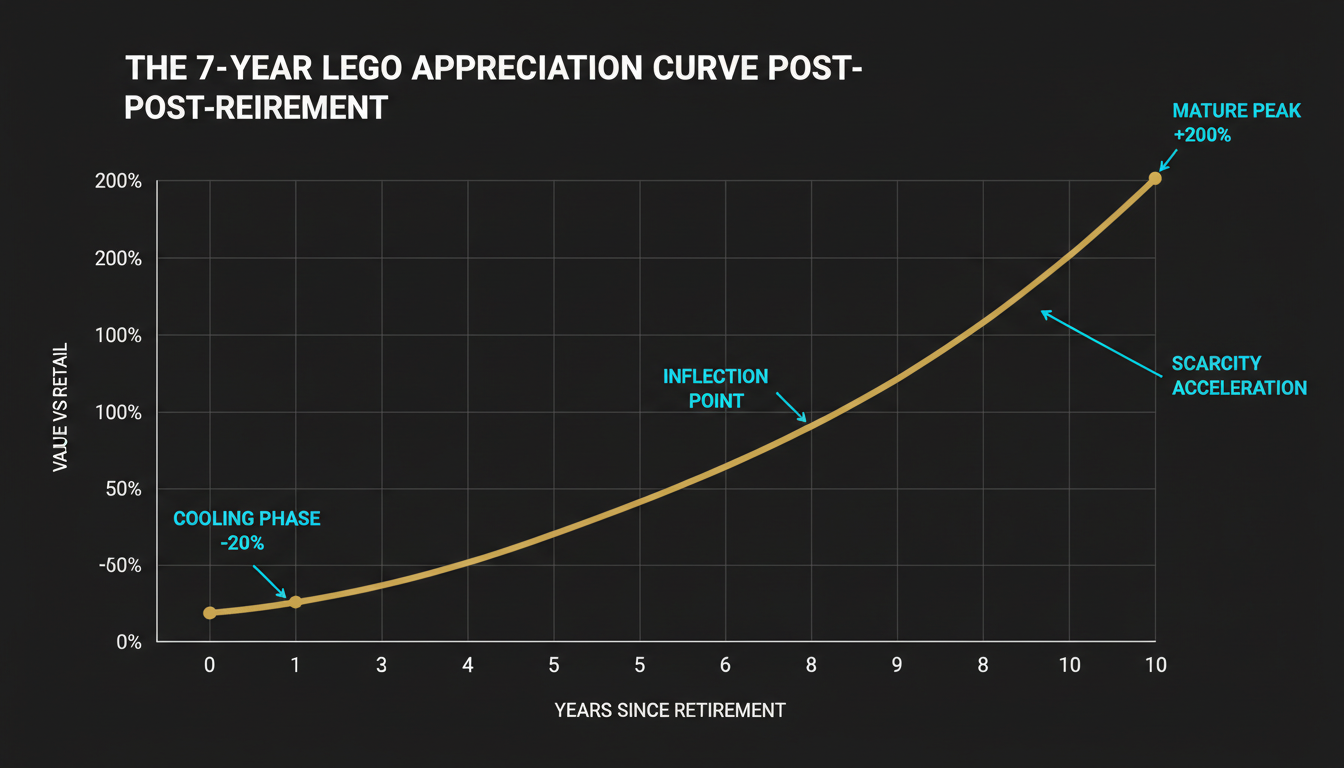
This is the shape that explains why retired-set investing is harder than it looks:
Years 0–2 post-retirement: the cooling phase. Most retired sets *lose* value relative to retail in the first 24 months after production ends. The reason is straightforward — major retailers (Target, Walmart, Amazon) are still clearing inventory at 15–25% off retail. That discounted retail stock acts as a price ceiling on the secondary market. A set that retailed at $200 will commonly sell for $160–$180 sealed during this window because Walmart still has it for $159.
Year 3: inflection. Retail discount inventory finally clears. Secondary-market becomes the only source. Prices start matching original retail. New buyers who weren't paying attention at launch start showing up.
Years 4–6: scarcity acceleration. The supply curve genuinely tightens. Sealed copies are being opened, damaged, lost. The pool of mint-sealed inventory shrinks at roughly 7% per year. Prices compound meaningfully — typical 15–25% annualized in this window.
Years 7–10: mature peak. The asset enters its long-run pricing regime. Annualized returns moderate to the HSE 11% baseline (or higher for top-tier themes). Most lifetime appreciation has happened by year 10; further gains track tier averages.
The implication for buying: the worst time to buy a retired set is months 1–24 post-retirement. The asset is structurally underwater versus retail during that window. The *best* time to buy a retired set you missed at retail is months 18–30 — late enough that retail inventory has cleared, early enough that the supply curve hasn't tightened. Buying in the "cooling phase dip" is the closest thing to alpha in LEGO investing.
5 currently-underpriced retired sets worth watching in 2026
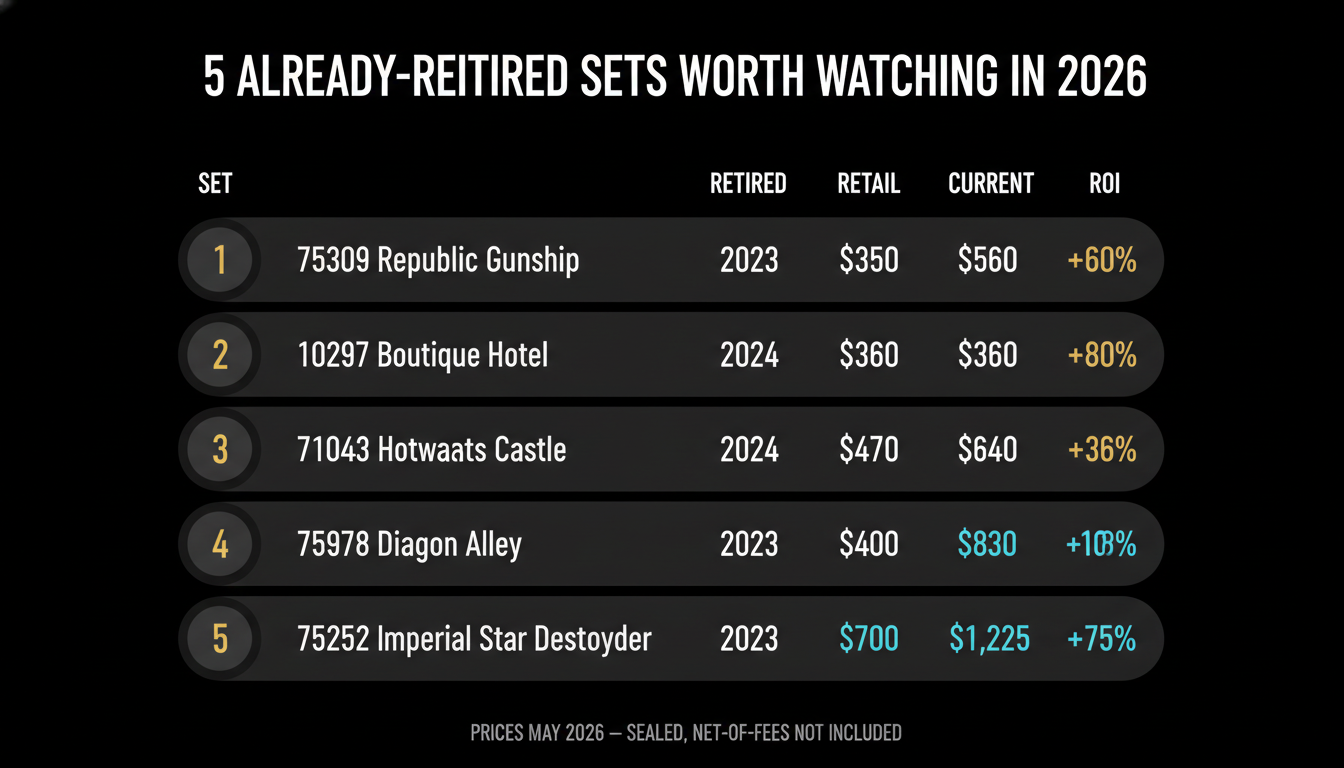
These are sets that have already retired, are past the cooling-phase dip, and based on tier multipliers and current secondary-market data have above-baseline expected forward returns. Prices are mint-sealed median sold listings across BrickLink + eBay (last 90 days, May 2026):
| Set | Tier | Retail | Current sealed | ROI to date | Forward 5Y (est) |
|-----|------|--------|----------------|-------------|------------------|
| 75309 Republic Gunship | Star Wars UCS | $349.99 | $560 | +60% | +120-150% |
| 10297 Boutique Hotel | Modular Buildings | $199.99 | $360 | +80% | +90-130% |
| 71043 Hogwarts Castle | Harry Potter UCS | $469.99 | $640 | +36% | +80-110% |
| 75978 Diagon Alley | Harry Potter UCS | $399.99 | $830 | +108% | +60-90% |
| 75252 Imperial Star Destroyer | Star Wars UCS | $699.99 | $1,225 | +75% | +70-100% |
75309 Republic Gunship — Retired late 2023. The only UCS-style Republic Gunship LEGO has ever produced, with a rabid Clone Wars fan base. The IP cycle is currently strong (the Tales of the Jedi animated continuation kept Clone Wars in the cultural conversation through 2025). At $560 sealed, this set is still well below where comparable retired UCS Star Wars sets typically peak (1.5–2x retail at year 5).
10297 Boutique Hotel — Retired 2024. The modular building tier compounds reliably. Long-run modular buildings typically peak at 2.5–3x retail at year 5–7 post-retirement. At $360 (1.8x retail), Boutique Hotel is still in the climbing phase of its curve.
71043 Hogwarts Castle — Retired 2024. The 2026 HBO Max Harry Potter reboot is the catalyst here. A retired-after-only-6-years UCS-class Harry Potter set going into a major IP revival event is one of the cleanest setups on the chart. Current $640 sealed is below where Harry Potter UCS sets historically settle.
75978 Diagon Alley — Retired 2023. Already up 108% from retail, which makes the percentage upside smaller but the absolute floor higher. Same IP revival tailwind as Hogwarts Castle. Worth holding if you already own; the buy case at $830 is weaker than the buy case at $640 for Hogwarts.
75252 Imperial Star Destroyer — Retired 2023. UCS-class Star Wars flagship, currently at 1.75x retail. Strong long-run pattern; the appreciation acceleration phase (years 4–6) is just starting.
Worth noting: 75192 Millennium Falcon isn't on this list because it hasn't retired yet (as of May 2026 it's still in active production). When it does retire — expected 2026 based on community consensus — it's the single biggest entry on any "watch list" for the next 24 months. We've covered the [whole 2026 picks portfolio](/blog/best-lego-sets-to-invest-in-2026) separately.
The 4 signals that flag a real bargain (versus a value trap)
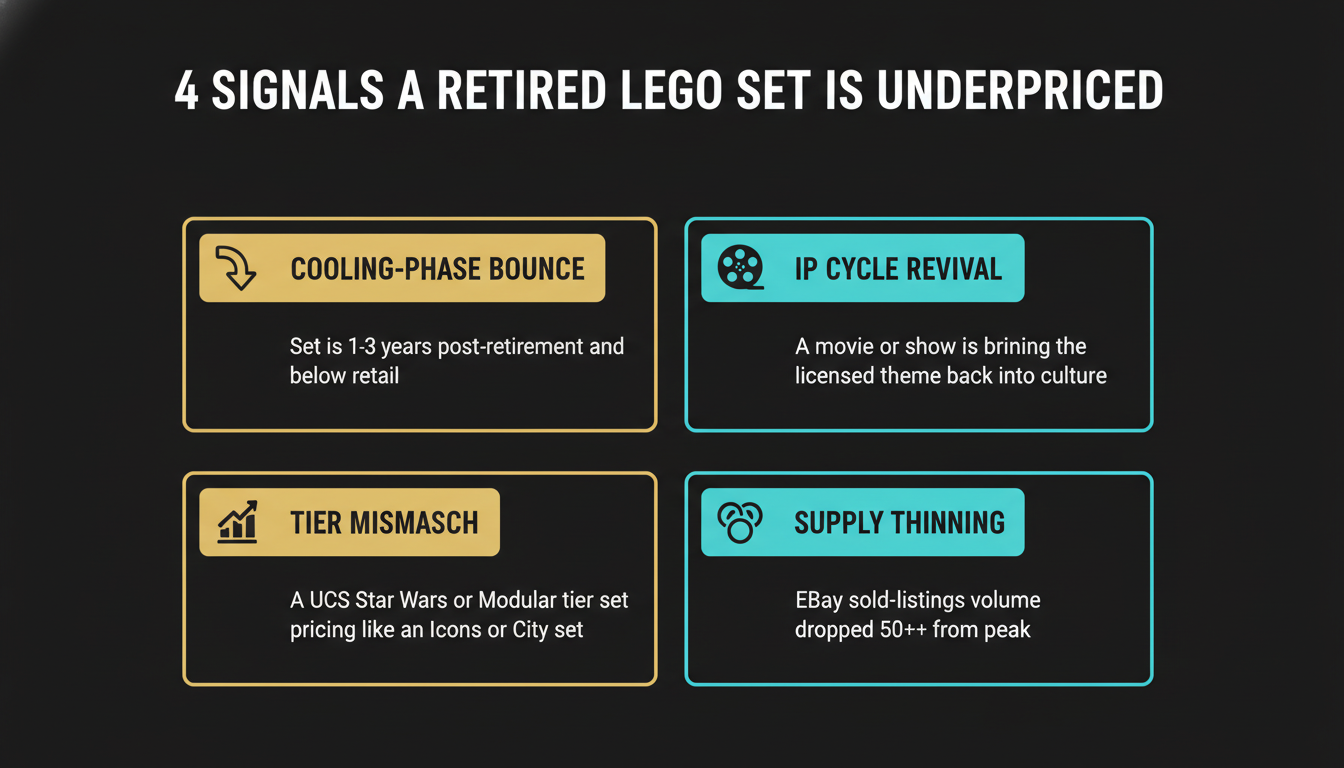
Three of these are quantitative (you can check the data). The fourth is qualitative.
Signal 1: Cooling-phase bounce
The set is 12–30 months post-retirement and currently trading below retail. This is a near-pure-alpha setup. The price will not stay below retail forever — retail inventory clears within 24 months in nearly all cases. Buying a sealed retired set below retail during this window is the closest thing to risk-free alpha in LEGO investing. The catch: very few sets meet this criterion at any given time, and they don't stay there long.
Signal 2: IP cycle revival
A movie, show, anniversary, or cultural moment is bringing the licensed theme back into demand. Hogwarts Castle in 2026 is the canonical example (HBO Max reboot landing). Sets to watch via this signal: anything Harry Potter going into 2026–2027, Lord of the Rings sets if Amazon's Rings of Power continues, any Marvel set retiring during a Phase 5 / Phase 6 high point.
The risk: cultural revivals can flop. Don't buy on this signal alone unless the tier multipliers also support the case.
Signal 3: Tier mismatch
The set belongs to a top-3 tier (UCS Star Wars, Modular Buildings, Ideas, Harry Potter UCS) but is currently priced like an Icons or City set. This usually means the set retired during a quiet period for its tier and didn't get the attention it should have. Periodic re-evaluation by collectors is the catalyst.
Republic Gunship is partially this story — UCS-class set that retired during a relatively quiet Star Wars year and is only now catching up to UCS-tier pricing norms.
Signal 4: Supply thinning
Last-90-days completed sold listings on eBay have dropped 50%+ from the post-retirement peak. This is the "supply is running out" signal. It's subtle and only visible if you watch eBay sold-data tab on the specific set over time. The [BrickLens portfolio tracker](/blog/lego-portfolio-tracker) surfaces this automatically; manual tracking via eBay's "sold listings" filter works too.
The risk: low sold-listing volume can also mean low demand. Cross-check with the asking-price trend (is it rising or flat?) before treating thinning supply as a buy signal.
How to actually buy a retired LEGO set without overpaying
The three real sources of retired sealed sets:
BrickLink is the gold standard for transaction transparency. Every seller is rated, every set has a price history, sold listings are visible. Fees are 3% to the seller. Buyers protected by Stripe / PayPal. The main downside: international sellers can have $40+ shipping that quietly erodes margin.
eBay has the largest inventory and the worst transparency. "Sold listings" filter is essential — never make a decision on asking-price listings, only completed sales. Watch for the "Best Offer accepted" flag, which usually means the listed price was 10–20% above what the set actually sold for. Fees are 13% to the seller and built into asking prices.
In-person — collector group sales, LEGO Discord servers, local fan clubs. This is the cheapest channel and the riskiest. No buyer protection, condition verification is on you, payment is usually cash or Venmo. Worth doing for high-value sets ($500+) only if you can physically inspect the box and verify seal integrity before paying.
For sets above $300 sealed, always insist on the seller photographing the box from all six sides (top, bottom, all four sides), plus a close-up of any seal corner. A surprising number of "sealed mint" listings turn out to be sealed-but-corner-creased once received. Sellers who refuse the photo request are red flags.
The fee math that erodes the headline number
The "current sealed value" numbers throughout this post are gross. The numbers you actually receive when selling are roughly 84% of gross on eBay (13% final-value fee + 3% PayPal), minus shipping costs that scale with set weight.
Concrete example using 71043 Hogwarts Castle: $640 gross sealed value × 0.84 = $537 net of fees, minus $35 for insured shipping on a 6kg box = $502 actually realized. That's still a +7% net return vs the $470 retail (assuming you bought at retail) — meaningfully different from the +36% gross number.
The fee drag is structural and affects every retired-set investment thesis. Most "LEGO returns vs S&P 500" comparisons quietly use gross LEGO returns versus net S&P returns. Adjusting for the LEGO fee tax brings LEGO's effective return down by 15–18% across the portfolio. The HSE 11% nominal becomes roughly 9% nominal net of fees. Still beats S&P 500 net (~8.5% post-tax-and-fees in most accounts), but the gap is narrower than the headlines suggest.
Bottom line
The median retired LEGO set returns roughly nothing. The mean returns +27.9%. The difference is selection — and selection follows predictable patterns once you understand the 7-year appreciation curve, the four buy signals, and the fee math.
If you want a quick framework: don't buy sets that retired in the last 18 months (cooling phase, structurally underwater); do watch the year-2-to-year-3 window for sealed-below-retail dips; focus on top-3 tiers (UCS Star Wars 17.6%, Modular Buildings 15.4%, Harry Potter UCS 13.75%) because the tier multiplier matters more than any single set; and always run the fee math before deciding whether the gross number is actually compelling.
For the live portfolio-tracking version of all of this — set-level ROI projections, tier-multiplier modelling, automatic alerts when a set you're watching crosses your buy threshold — that's what [the BrickLens app](/) does. The [investment calculator](/tools/investment-calculator) does the same for one-off "should I buy this specific set" decisions.
Related reading: [is LEGO a good investment](/blog/is-lego-a-good-investment), [the real LEGO appreciation rate](/blog/lego-appreciation-rate), [LEGO sets retiring in 2026](/blog/lego-sets-retiring-2026), [most valuable LEGO sets](/blog/most-valuable-lego-sets).