LEGO Price Per Piece: The Buyer Metric That Actually Matters (2026 Guide)
"Price per piece" is the most-discussed LEGO buying metric, and one of the most-misused. Get it right and it cuts through marketing noise to tell you whether a $200 set is actually a deal. Get it wrong and it leads you to spend $20 on a Creator 3-in-1 set with 250 generic plates that you'll never display or build twice.
The current LEGO baseline is about $0.10 per piece. That's the official average across all current production, validated by [LEGO's own pricing explanation](https://www.lego.com/en-ca/service/help-topics/article/how-we-decide-the-prices-of-lego-sets), Brickset's bulk-lot calculator article, and the long-running BrickEconomy database. Anything under $0.10/piece is "cheap" by tier average; anything above is paying a premium for something — licensing, exclusivity, unique molds, or all three.
This guide walks how to use price per piece honestly: the line-by-line breakdown, the 30-year historical context (PPP has *fallen* dramatically, adjusted for inflation), the four cases where above-baseline pricing is justified, and the trap cases where low PPP is actually a value trap.
The current $/piece by LEGO line (2026)
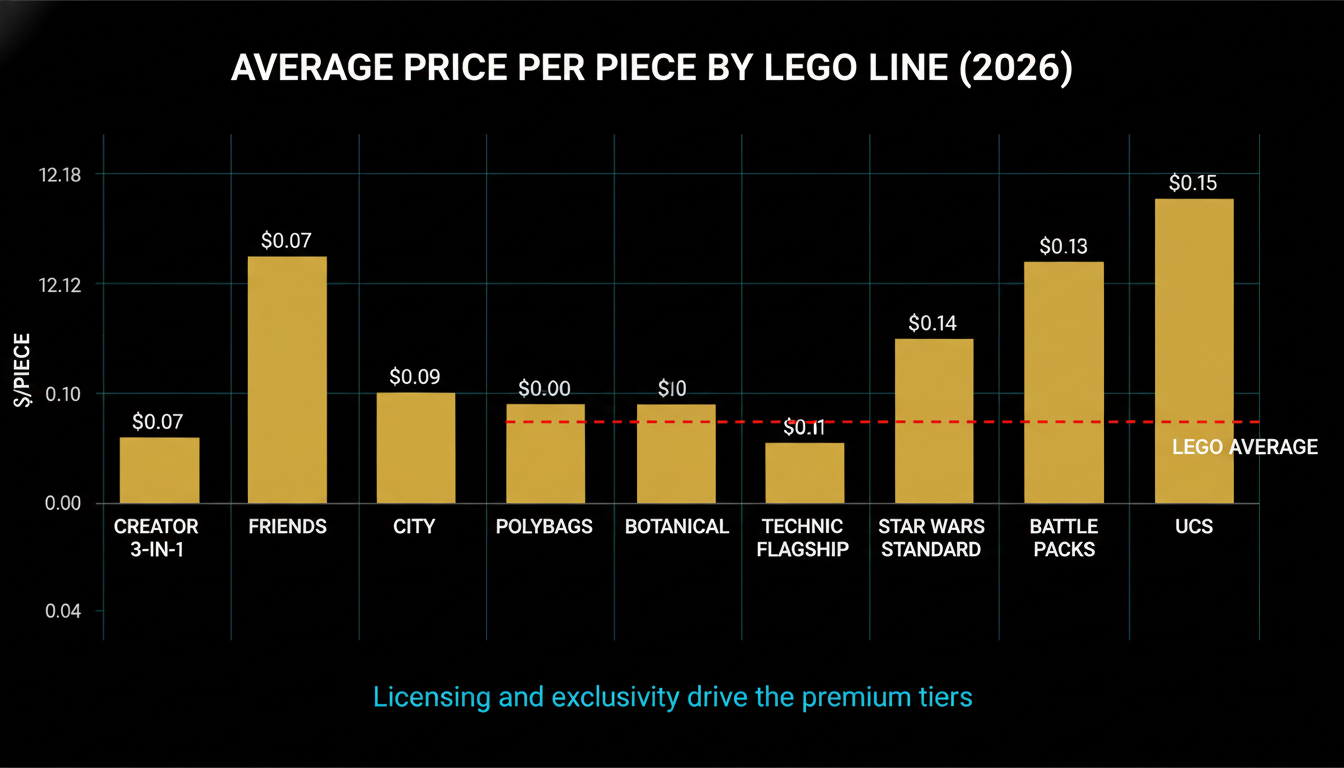
| LEGO line | Typical $/piece | Notes |
|-----------|-----------------|-------|
| Creator 3-in-1 (medium) | $0.07-$0.09 | Generic parts, no licensing, three-build flexibility |
| LEGO City | $0.08-$0.10 | Mass-market scale, standard parts mix |
| LEGO Friends | $0.09-$0.11 | Specialty pieces (figs/colors) bump it slightly |
| Polybags | $0.05-$0.11 | Wide range — depends entirely on what's inside |
| LEGO Botanical Collection | $0.09-$0.11 | Mostly stems and small plates |
| Technic standard | $0.10-$0.12 | Engineering parts more expensive per unit |
| LEGO Icons (standard) | $0.10-$0.12 | Mid-tier; varies by licensing |
| LEGO Star Wars (standard) | $0.11-$0.14 | Licensing fee is real |
| Disney 18+ | $0.10-$0.14 | Adult line markup |
| LEGO Star Wars Battle Packs | $0.14 | Minifig-heavy = higher per-piece, lower per-minifig |
| UCS (display flagships) | $0.13-$0.17 | Premium pricing for display-grade builds |
| LEGO Ideas (exclusive) | $0.10-$0.14 | Variable; some at baseline, some premium |
A few patterns worth noticing:
The cheapest lines are Creator 3-in-1 and LEGO City — exactly the lines with the weakest secondary-market resale demand. That's not coincidence. Low $/piece signals high parts standardization, which signals weak collector differentiation, which signals weak resale demand. Creator 3-in-1 sets retire and barely budge from retail.
The most expensive lines are UCS and Battle Packs — but for opposite reasons. UCS pays for size and display-grade engineering. Battle Packs pay for minifig density (the per-minifig cost in a battle pack is *better* than buying figures standalone). We walked through the [75372 battle pack economics](/blog/lego-star-wars-battle-droids) — $30 retail, $51 worth of minifigs.
The lesson: $/piece is a useful first filter but a terrible final decision criterion. The full picture requires asking what the parts actually are, who buys them later, and whether you'll display or resell.
The 30-year history of LEGO pricing
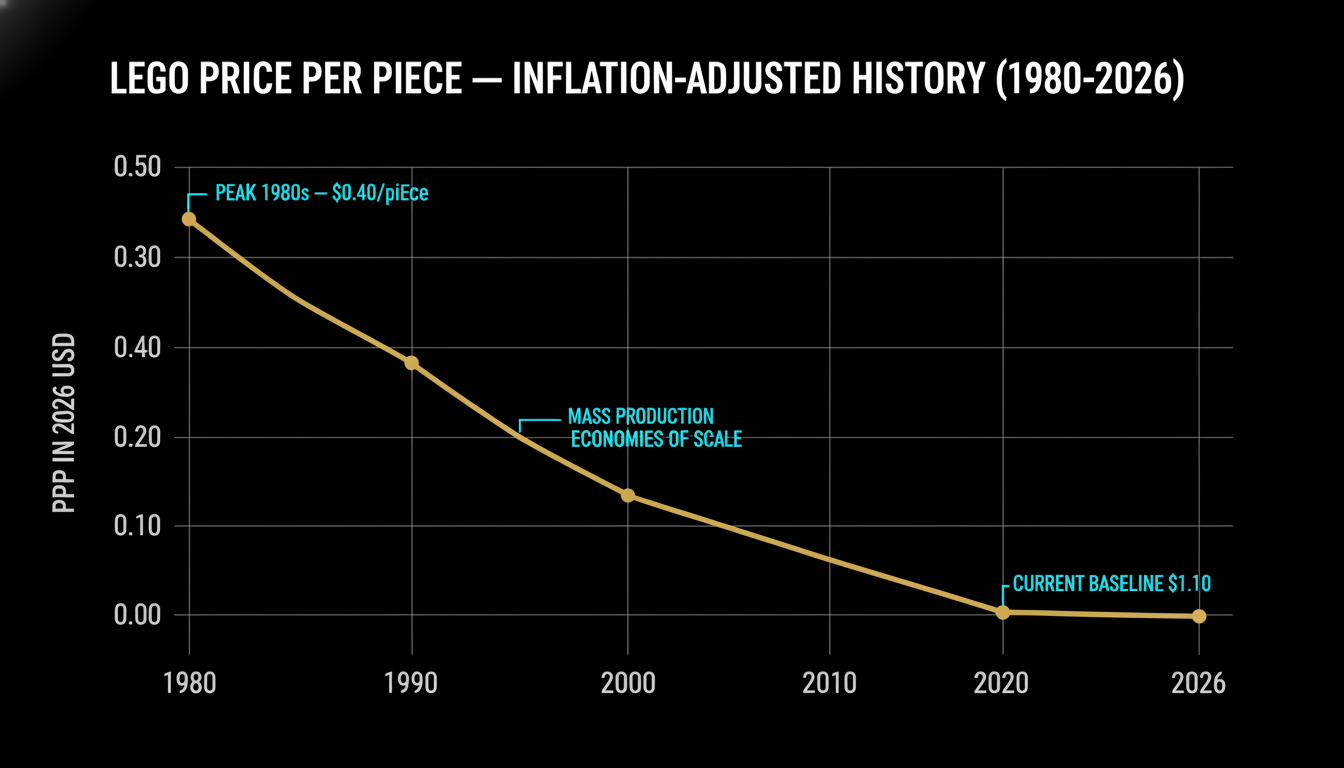
Inflation-adjusted, LEGO is dramatically cheaper now than it was 30+ years ago. The Bricks Stack Exchange thread documenting [LEGO PPP history](https://bricks.stackexchange.com/questions/1196/what-is-the-average-price-per-piece) puts the trajectory in 2026 dollars at:
1980: ~$0.40 per piece (real cost in 2026 dollars)
1990: ~$0.25 per piece
2000: ~$0.18 per piece
2010: ~$0.13 per piece
2020: ~$0.11 per piece
2026: ~$0.10 per piece
The 4x cost decline reflects three structural shifts: dramatically more efficient injection-molding processes, mass-market production scale (LEGO's annual unit output is ~5x what it was in 1990), and aggressive license-leveraging (Star Wars and Marvel licenses subsidize the whole catalog).
The implication for buyers in 2026: historical "LEGO is expensive" framing is largely outdated. The real cost has fallen 75% in inflation-adjusted terms. What changed is that adult collectors now buy bigger sets at higher absolute prices, so the *total spend* feels higher even though per-piece cost is at an all-time low.
If you're a parent comparing LEGO to your own childhood pricing: yes, the headline absolute prices are higher, but the per-brick cost is dramatically lower. A 1985 $20 set was actually $48 in today's money for 50 pieces ($0.96/piece). A 2026 $20 set is 200+ pieces ($0.10/piece). Better deal on every dimension.
When paying above $0.10/piece is justified
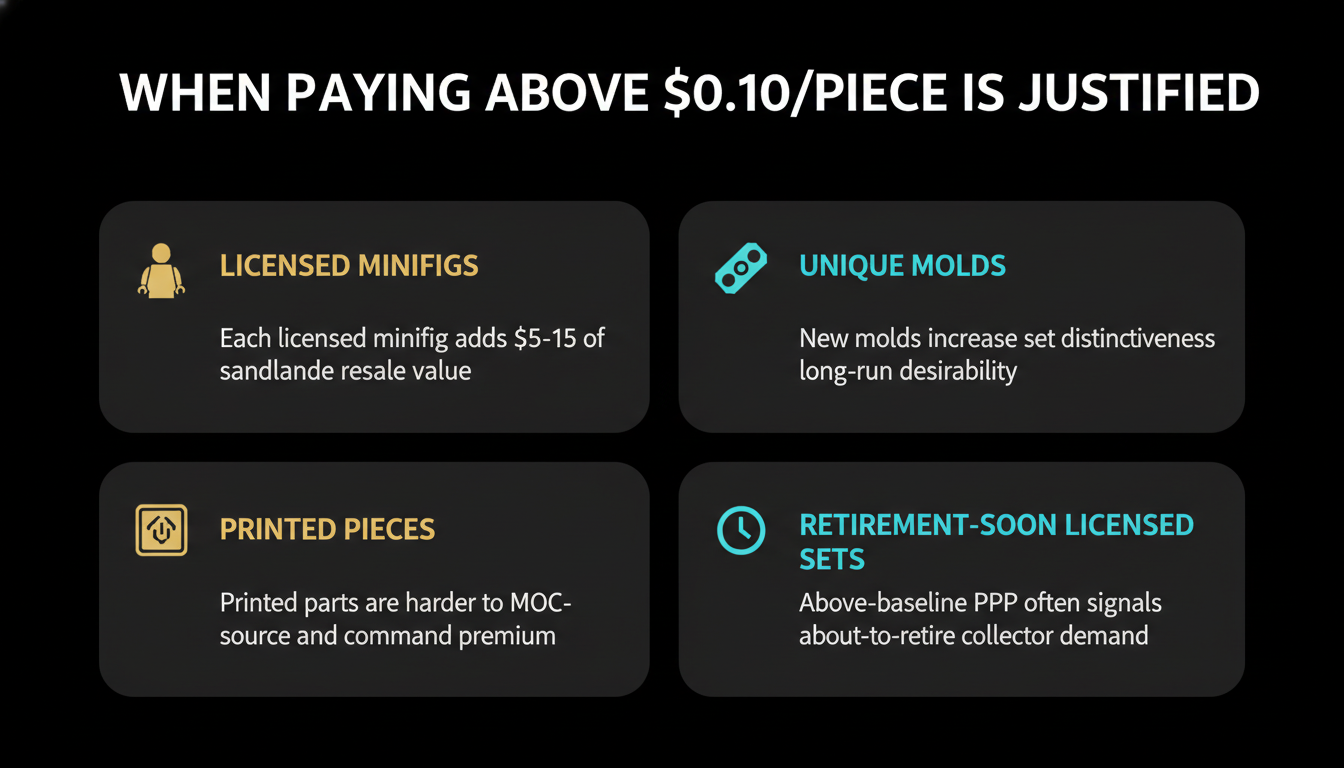
Four cases where above-baseline PPP delivers genuine value:
1. Licensed minifigures
A licensed minifig (Star Wars, Marvel, Harry Potter, etc.) carries about $5-$15 of standalone resale value on BrickLink. A set with 4 licensed minifigs has $20-$60 of "embedded minifig equity" before you count the build at all. This justifies $0.12-$0.15/piece pricing on small Star Wars sets that would otherwise look overpriced.
The math: if you're paying $40 for a 250-piece Star Wars set with 4 minifigs at $0.16/piece, the minifig equity is approximately $30 of that. The actual brick cost is $10 / 250 = $0.04/piece. That's *under* the baseline once you account for the embedded figure value.
2. Unique molds (new piece designs)
LEGO routinely introduces new mold designs for specific sets — a custom dragon head, a new wing shape, a specialized vehicle hull piece. These molds are expensive to develop (typically $50-$200K per new mold), and the cost is amortized across the sets that use them. Sets containing 5+ new molds command above-baseline PPP because each new mold adds genuine value — both for distinctive builds and for MOC builders who can't easily source the part elsewhere.
How to identify: BrickLink and Rebrickable both flag "new for 2026" parts in their set inventories. If you see a high proportion of newly-introduced part numbers, the above-baseline PPP is justified.
3. Printed pieces (not stickers)
LEGO sometimes uses stickers and sometimes uses printed pieces (where the design is permanently molded onto the brick). Printed pieces are significantly more expensive to produce — each print adds ~$0.02-$0.05 of unit cost — and they hold their value because they can't be re-sourced cheaply on BrickLink. Sets that use printed pieces instead of stickers tend to sit $0.02-$0.04/piece above baseline.
The collector preference is strongly for printed over stickered. A set with 20 printed tiles will outperform a set with 20 stickered tiles by 5-10% in long-run resale value. The above-baseline PPP is partly paying for the prints, partly paying for future-buyer preference.
4. About-to-retire licensed sets
LEGO sets with end-of-life signals (long production run, "Retiring Soon" tag, partial retailer unlisting) often command above-baseline PPP at retail because collectors are bidding them up before they disappear. This is forward-looking pricing — you're paying for the post-retirement appreciation curve that's about to start.
Example: 71043 Hogwarts Castle is at roughly $0.078/piece retail ($469.99 / 6,020 pieces) — *below* baseline because it's a UCS-class set in a tier that should command premium. The pricing is anomalous in the buyer's favour because LEGO priced the set conservatively at launch in 2018 and hasn't raised it. Sets like this — UCS-tier asset priced like a mid-tier set — are the textbook above-baseline-justified buy.
The trap: when low PPP signals bad value
Three common low-PPP traps:
Creator 3-in-1 large sets ($0.07/piece). Cheapest PPP in the catalog. Almost zero resale value because the builds are interchangeable parts and target builders, not collectors. Fine for kids, terrible for portfolios.
LEGO Education sets (when accessible). Even cheaper PPP for high-quality parts mixes. But Education sets are sold through limited channels (school districts, official Education resellers) and the buyer base is non-collector. Low resale, narrow audience.
Bulk parts lots / Pick-A-Brick. Pick-A-Brick is the absolute cheapest per-stud cost LEGO sells. But you're buying parts, not sets, and parts have weaker individual resale than complete sets. For MOC builders this is the right channel; for portfolio buyers it's irrelevant.
How to actually use price per piece
The honest workflow:
Calculate PPP for any set you're considering: retail price / piece count.
Compare to the line baseline from the table above. Above baseline → ask why.
Identify the premium driver: licensing? Unique molds? Printed parts? About-to-retire? Display-grade build?
Decide whether the premium is worth it to you. For collectors and investors: usually yes if drivers 1-4 above are present. For pure builders: usually no — Creator 3-in-1 and City deliver the most build content per dollar.
For resale candidates only: cross-reference against BrickEconomy's parts-out estimator. The standard rule is pay maximum 1/3 of part-out value if you're planning to break a set down for parts.
The [BrickLens app](/) handles PPP calculation and tier-comparison automatically — scan a set's barcode and you get PPP plus how it compares to its category. The [investment calculator](/tools/investment-calculator) takes it one step further by projecting expected return based on the tier multiplier.
Bottom line
Price per piece is a useful first filter, not a final decision criterion. The LEGO baseline in 2026 is $0.10/piece — dramatically lower than 30 years ago in inflation-adjusted terms, and lower than the historical "LEGO is expensive" framing suggests.
Above-baseline PPP is justified when sets contain licensed minifigs, new molds, printed pieces, or about-to-retire collector signals. Below-baseline PPP is sometimes a great deal (Creator 3-in-1 if you're a parts buyer) and sometimes a trap (Education and Pick-A-Brick if you're a portfolio buyer).
If "is this LEGO set a good deal" is the question you're trying to answer, the workflow is: calculate PPP, compare to line baseline, identify the premium driver, decide whether the driver matches your use case. That five-step framework captures everything actually useful about PPP without falling into the simplistic "lower is always better" trap.
Related reading: [the cheapest LEGO sets that are actually worth it](/blog/cheapest-lego-sets), [LEGO Star Wars battle droids — the 75372 ROI case](/blog/lego-star-wars-battle-droids), [is LEGO a good investment](/blog/is-lego-a-good-investment), [the LEGO appreciation rate](/blog/lego-appreciation-rate).