LEGO Pit Droid (Set 8000): 24 Years of Investment Returns, Analyzed
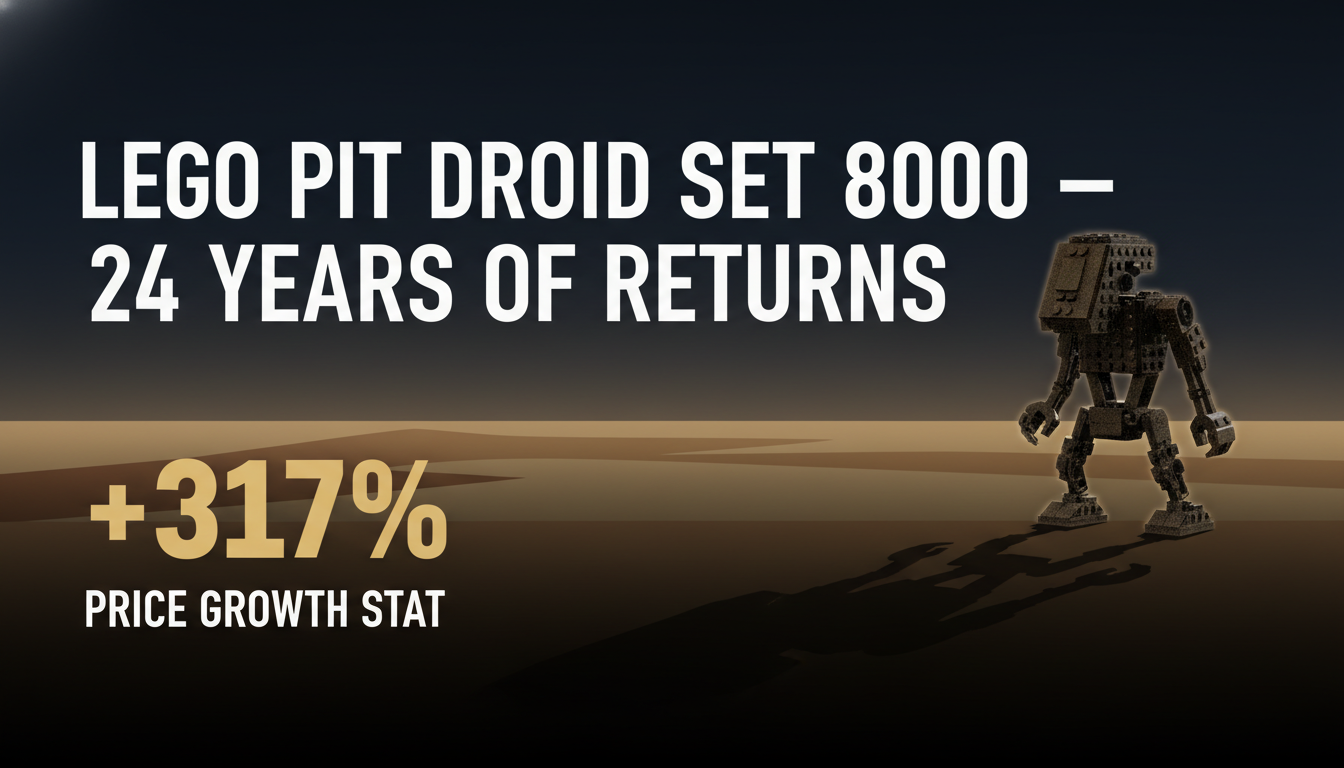
LEGO 8000 Pit Droid launched in January 2000 at $19.99. It retired in December 2001 after less than two years on shelves. In 2026, a sealed copy trades between $73 and $96 on BrickLink — with an average market value around $83.
Three hundred and seventeen percent total growth sounds like a headline. Annualized over 24 years it works out to a 5.13% CAGR. That is above CPI inflation most years. It is meaningfully below the 11% baseline the Higher School of Economics found across 2,322 retired LEGO sets in their 2022 study. And it is the third-worst return in the nine-set Star Wars Technic subtheme, beating only the Stormtrooper (112%) and R2-D2 (175%).
The Pit Droid is a legitimate vintage Star Wars collectible with a real secondary market. It is not an elite LEGO investment. This analysis breaks down why, where it fits in the subtheme, and whether buying one in 2026 makes any sense.
What LEGO Set 8000 Actually Is
Set 8000 is a 223-piece Technic buildable figure representing a DUM-series pit droid from Star Wars Episode I: The Phantom Menace. It was part of the inaugural wave of LEGO Star Wars Technic models — a 2000 experiment where LEGO applied its Technic building system to large-scale character figures rather than vehicles or machines.
The build itself is a folded droid in dormant position. A spring and rubber-band mechanism in the torso activates when you press the nose — the droid snaps upright into its standing position. Colors are primarily tan and green. The tan was notable at the time: it had not previously appeared in Technic sets, and the parts from set 8000 are still among the earliest tan Technic components in any collection.
Piece count is 223. No minifigures. Retail was $19.99 in the US and £12.99 in the UK. Price per piece at retail: approximately $0.09 — extremely good value for a display-scale figure.
The set launched January 2000, retired December 2001. Shelf life was under two years, which is shorter than the typical major LEGO set. Short shelf lives tend to correlate with lower production volumes, which creates the supply scarcity that underpins long-term secondary-market appreciation.
The Full Star Wars Technic Subtheme — Comparison Table
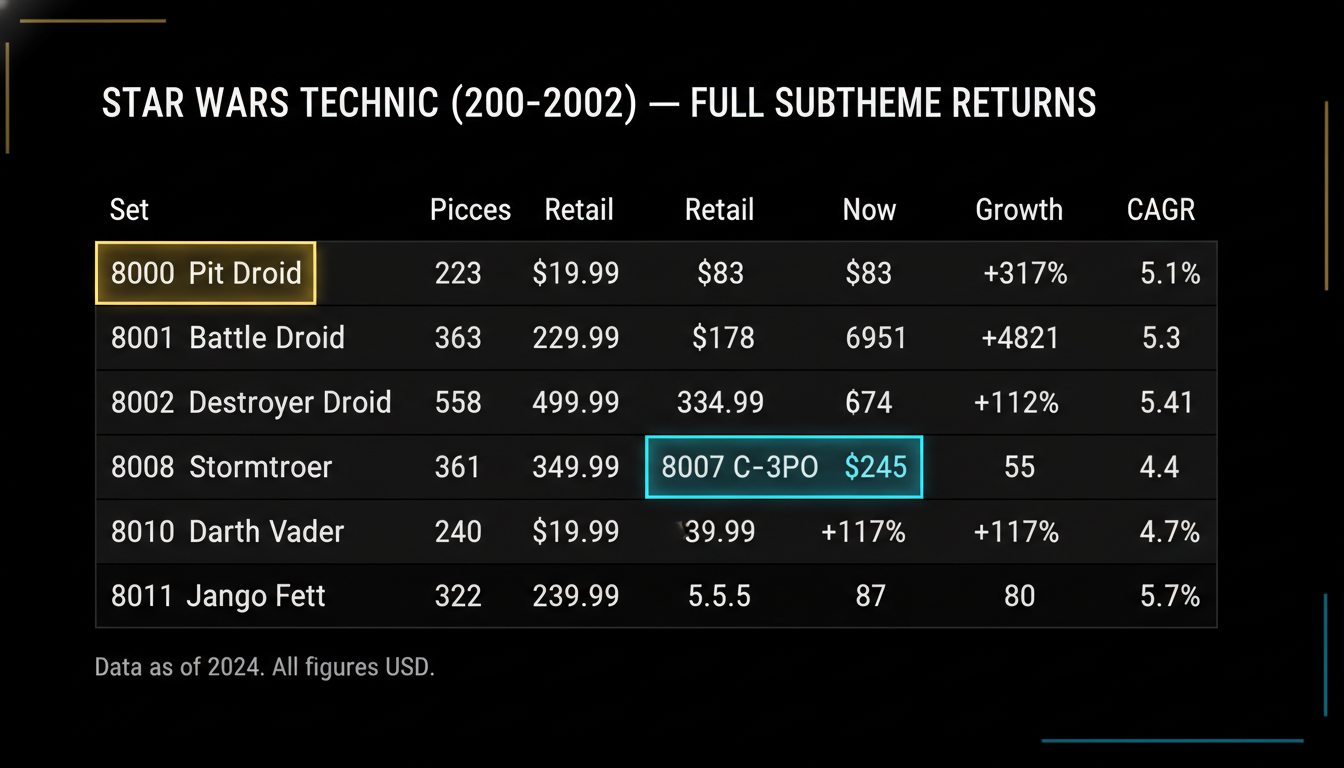
LEGO produced nine Star Wars Technic buildable figures between 2000 and 2002. All nine are now retired. Here is where set 8000 stands among its peers:
| Set | Name | Pcs | Retail | Now (sealed) | Growth | CAGR |
|-----|------|-----|--------|--------------|--------|------|
| 8000 | Pit Droid | 223 | $19.99 | $83 | +317% | 5.1% |
| 8001 | Battle Droid | 363 | $29.99 | $178 | +495% | 5.3% |
| 8002 | Destroyer Droid | 558 | $49.99 | $291 | +482% | 5.1% |
| 8007 | C-3PO | 341 | $34.99 | $245 | +601% | 6.7% |
| 8008 | Stormtrooper | 361 | $34.99 | $74 | +112% | 4.4% |
| 8009 | R2-D2 | 240 | $19.99 | $55 | +175% | 4.7% |
| 8010 | Darth Vader | 391 | $39.99 | $87 | +117% | 5.5% |
| 8011 | Jango Fett | 422 | $29.99 | $80 | +167% | 5.7% |
| 8012 | Super Battle Droid | 379 | $34.99 | $98 | +180% | 6.7% |
The subtheme average CAGR is approximately 5.13%. The Pit Droid sits right at the subtheme median. The best performer is C-3PO at 6.7% CAGR and +601% total — driven by the universal recognition of that character across all six original and prequel films. Destroyer Droid is the highest absolute-dollar appreciator ($291) because it started at a higher retail price of $49.99.
The Stormtrooper underperformed for a different reason: it was heavily restocked and widely distributed before retirement, keeping secondary supply elevated. The R2-D2 faces a similar problem — too many units in circulation even decades later.
The Pit Droid's 5.1% CAGR relative underperformance compared to C-3PO is straightforward: it is an Episode I-only character with limited broad appeal. Collectors who want a Star Wars Technic display piece typically reach for the more iconic characters first. The Pit Droid is the character from a film that divided the fandom.
Price Appreciation Over 24 Years
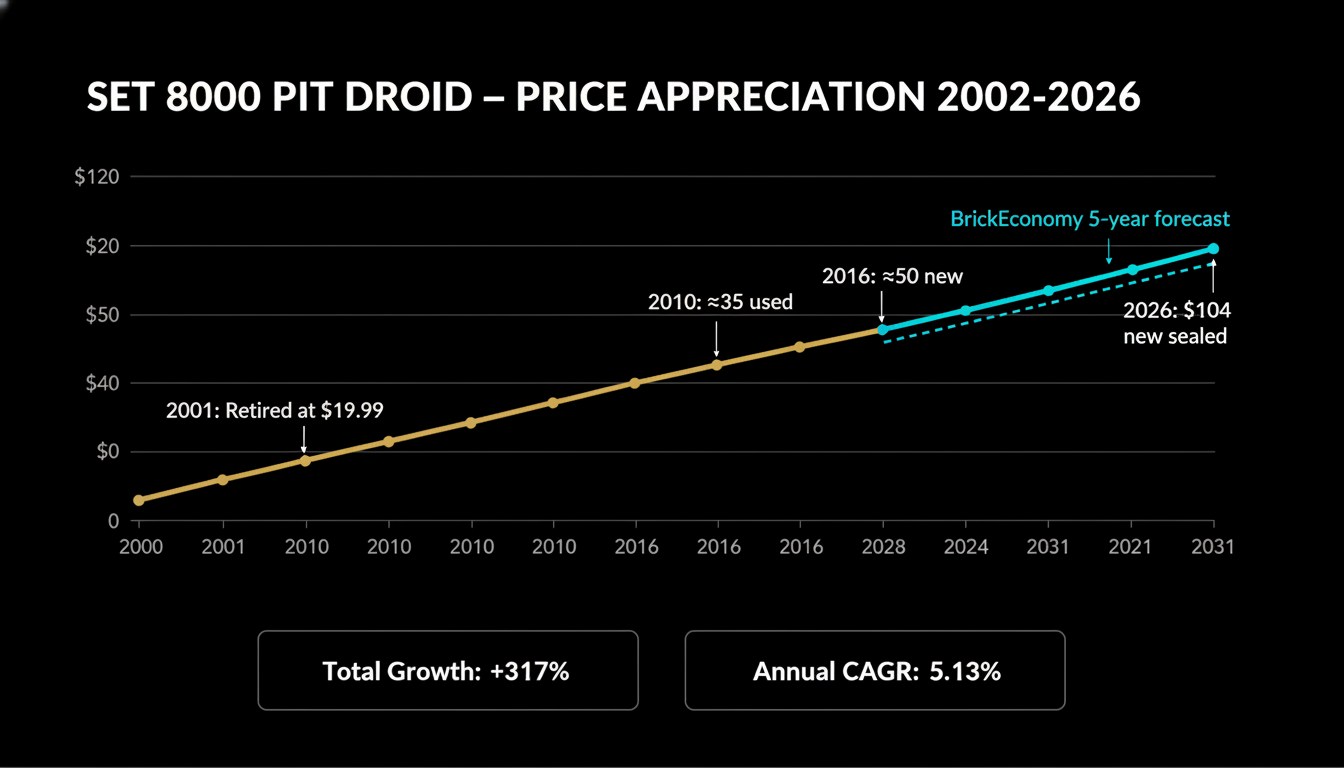
The appreciation curve for set 8000 is roughly what you expect from a quietly retired vintage Star Wars set: gradual and steady rather than explosive.
A rough reconstruction of the price curve:
2001 (at retirement): $19.99 retail — secondary market near retail
2010: approximately $35 used, $45 new sealed on early eBay listings
2016: approximately $50 new sealed, $22 used
2020: approximately $65 new sealed (Episode I 20th anniversary interest)
2026: $83 BrickEconomy estimate, $99.87 BrickRanker six-month average
The discrepancy between BrickEconomy's $83 and BrickRanker's $99 reflects the thin market. BrickRanker reports the average of actual eBay sold prices over six months. BrickEconomy reports an estimated market value derived from BrickLink listings and historical data. When a set sells once or twice a year, a single high or low transaction moves the average significantly.
BrickEconomy's five-year forecast for set 8000 is $104.45 — implying continued 5.13% annual appreciation through 2031. That is their base case. The pessimistic case holds at $101, the optimistic at $107. The narrow range reflects how well-established this appreciation curve is: the set is not going to suddenly spike because of a remake or a new film, and it is not going to crash because the market already knows what it is.
What Actually Drives the Price
A few structural factors support the Pit Droid's steady appreciation:
No remake risk. LEGO has not produced a new DUM-series pit droid Technic figure since 2002. Remake risk is the single biggest destroyer of vintage LEGO value — when LEGO re-releases a popular set (or creates a newer version of the same character at better scale and price), the original's value compresses. The Pit Droid faces no such threat. LEGO has moved away from the Technic buildable-figure format entirely for Star Wars characters.
Thin supply. A 2001 retirement with less than two years of shelf life means there were never enormous quantities in the distribution channel. Sealed copies are scarce, and the scarcity is real — not manufactured by an artificial retirement.
Episode I recognition. The fandom reaction to Episode I has softened considerably over 25 years. Collectors who grew up with The Phantom Menace in 1999 are now adults with disposable income and nostalgia-driven purchasing behavior. This has supported demand for Episode I sets specifically over the 2018–2026 window.
No minifigures. Counterintuitively, the absence of minifigures is a mild positive here: no risk that a single minifigure depreciates due to a reprint in a cheap polybag. The entire value is in the sealed build.
Market Liquidity Warning
Here is the single biggest practical concern with set 8000 as an investment: it barely trades.
BrickRanker shows approximately one to two eBay sales per year for set 8000 new/sealed. BrickEconomy's confidence intervals reflect this — the $73 to $96 range on a $83 average is a 14% spread on a set with almost no market activity. You could list it at $95 and wait six months for a buyer. You could list it at $73 and move it in a week. Price discovery is unreliable when annual transaction volume is measured in single digits.
This matters for investment planning. The standard LEGO investment workflow — "list on eBay, let it sell at market" — assumes a market actually exists. For set 8000, you are targeting a very specific buyer: someone who wants that exact vintage Star Wars Technic piece, in sealed condition, right now. Those buyers exist, but they are rare.
Compare this to LEGO 75192 Millennium Falcon (UCS), which has hundreds of sealed transactions per month. Price discovery is tight, liquidity is real, and selling at market takes days, not months. For pure investment purposes, liquidity matters as much as headline appreciation rate.
Should You Buy Set 8000 in 2026?
Current BrickLink prices range from $60 at the low end to $116.28 at the high. The $60 copies are almost certainly used or incomplete. Expect to pay $75–$95 for a credible sealed-mint copy from a reputable BrickLink seller.
At $80 entry with a projected five-year value of $104 (BrickEconomy base case), your gross return is approximately 30% over five years — or about 5.3% annualized. Subtract eBay fees of 13% plus PayPal fees of 3% plus shipping on the sale side, and your net return on the liquidation side drops to roughly 12–15% net over five years. That is not a compelling pure-investment case.
The honest verdict:
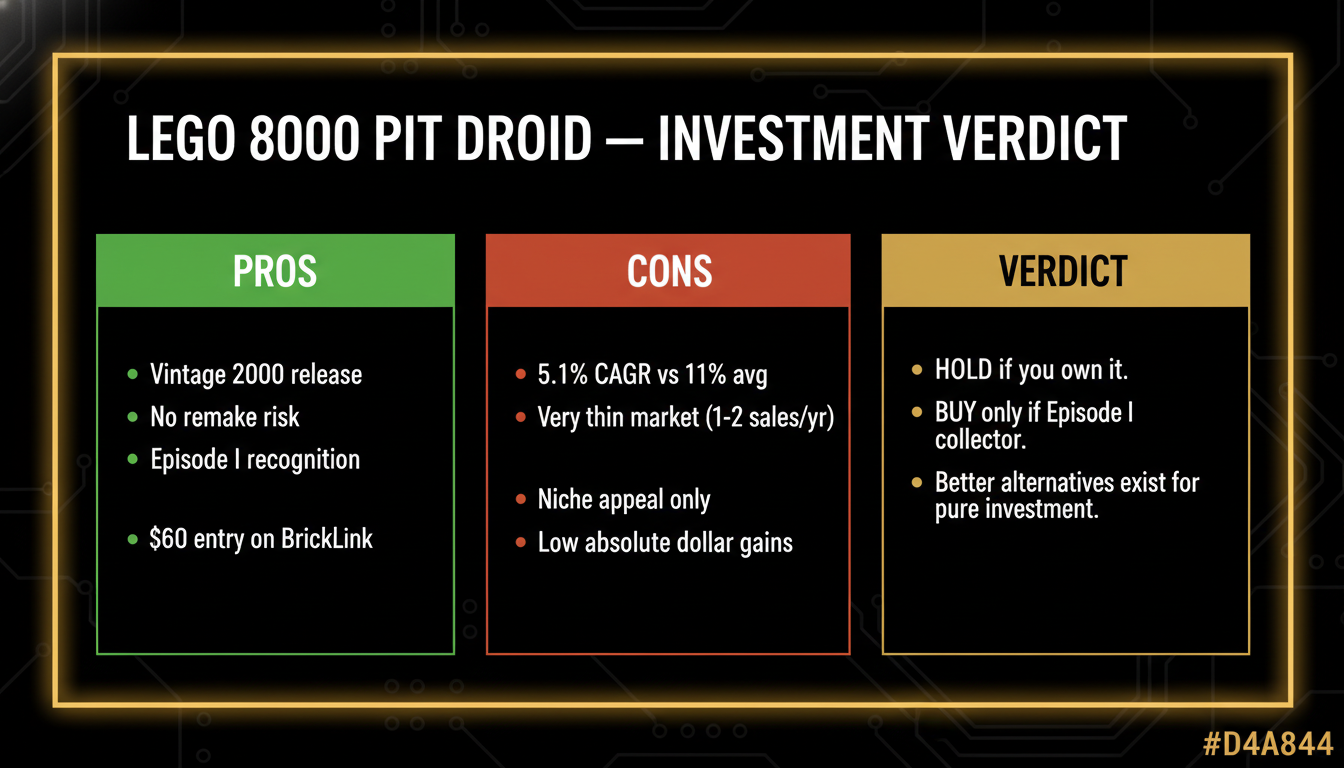
Hold if you already own it. The appreciation is real and steady. There is no reason to liquidate a 24-year vintage set you bought at or near retail. Let it appreciate.
Buy if you are an Episode I collector. The Pit Droid is a legitimate piece of Star Wars Technic history. If you want the complete 2000–2002 subtheme on your shelf, $80–$90 is a reasonable price for a sealed copy. Buy it for the collection, not the return.
Skip if you are deploying capital for pure investment return. Five percent CAGR with single-digit annual sales is not where your LEGO investment budget should go. At $80 entry you would need to hold for over a decade to generate meaningful nominal gains, and the thin market creates real execution risk when you try to sell.
Better alternatives for pure investment in the same Star Wars vintage tier: C-3PO (8007) at approximately $240 new offers better long-term appreciation, broader collector demand, and higher absolute-dollar upside. If that is outside your range, the Destroyer Droid (8002) at roughly $290 is the best absolute-return story in the subtheme.
How to Buy If You Want One
The best sources for vintage LEGO in sealed condition are BrickLink (multiple sellers with verifiable feedback), eBay (search "LEGO 8000 new sealed," filter sold listings to calibrate price), and specialized LEGO collector groups on Facebook and Reddit.
Condition checklist for a sealed copy:
All original seals intact — no tape repairs, no replaced shrink wrap
Box corners: look for crushing, moisture damage, or fading
No barcode stickers applied directly to the set window (common on ex-shelf copies)
Seller feedback minimum 98% positive with 50+ transactions
Use BrickLens to track market price history and set price alerts at your target entry. The app connects to live secondary market data and will notify you when a listing hits your price — useful for a set this thinly traded, where waiting patiently for the right seller beats overpaying in the moment.
Bottom Line
LEGO 8000 Pit Droid is a legitimate 24-year vintage collectible with real appreciation, real collector demand, and real scarcity. Its 5.1% CAGR is solid — better than most savings accounts, better than gold over the same period, but meaningfully below the best-performing LEGO themes.
The thin market is the investment-case killer. One or two trades per year means you cannot confidently exit at the stated market price. If you need to sell, you need the right buyer, and that buyer might take months to find.
For comparison and context on where LEGO investing actually generates its strongest returns, the tier framework in [best LEGO sets to invest in 2026](/blog/best-lego-sets-to-invest-in-2026) shows why UCS Star Wars, Modular Buildings, and LEGO Ideas systematically outperform vintage Episode I Technic over a ten-year horizon. The Pit Droid is a great collection piece. It is a middling investment.
Related reading: [LEGO appreciation rate — the full data analysis](/blog/lego-appreciation-rate), [most valuable LEGO sets of all time](/blog/most-valuable-lego-sets).