The LEGO Portfolio Tracker Playbook: What to Track, How to Track It, Which Tools Actually Work
Most "LEGO portfolio trackers" are just price-check tools with a saved-list feature bolted on. That's not what a portfolio tracker is. A real portfolio tracker answers three questions simultaneously: *what is my collection worth right now, is it on track to hit my target return, and when should I sell each set.*
If all you want is "what is set X trading at today" you don't need a portfolio tracker — [BrickEconomy's set page](https://www.brickeconomy.com) or [BrickLink's price guide](https://www.bricklink.com/catalogpg.asp) does that for free. The reason to set up a proper portfolio tracker is that LEGO is illiquid, theme-cyclical, and condition-sensitive — so the *portfolio-level* view is what actually drives returns, not individual set spot prices.
This post is the playbook we'd give a friend who's serious about treating their collection like an investment portfolio. Five metrics to track, a six-step workflow, and an honest comparison of the top tools (including ours).
Why spot price alone is not a portfolio
Three realities make single-set spot prices misleading at portfolio level:
Basis matters more than value. A Hogwarts Castle at $650 sealed means nothing until you know whether you paid $470 retail in 2023 (now +38%) or $620 on the secondary market in 2024 (now +5%). Spot price is noise without basis.
Tier concentration risk is real. A collection that's 70% Star Wars UCS and 30% Marvel might look balanced on a set list. It's not — it's a two-tier bet with IP-cycle correlation. Real trackers show concentration.
Realized return ≠ listed value. The number on BrickEconomy is the median sold-listing price *gross*. Net of eBay (13%), PayPal (3%), and shipping (often $20-30 on heavy UCS), realized return is 15-18% lower. Track gross, act on net.
A proper portfolio tracker rolls all three into one view. That's the bar.
The 5 metrics a real tracker must show
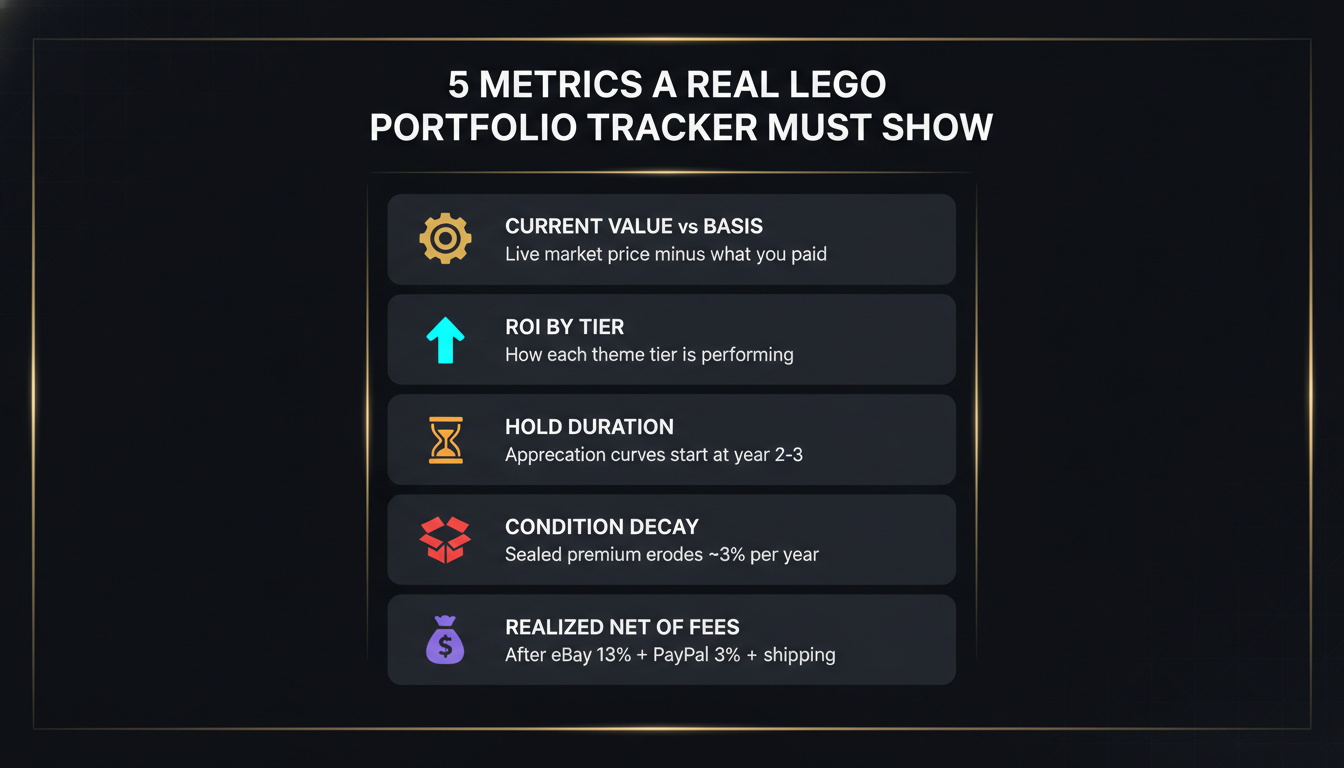
1. Current value vs basis (per set and aggregated)
Live market price minus what you paid. This is the fundamental P/L calculation, and most tools get it wrong by forgetting the "what you paid" half. Your spreadsheet minimum: purchase date, purchase price (including tax + shipping), current median-sold price from BrickEconomy or BrickLink. Subtract; percentage; done. If your tracker doesn't support *actual purchase price* as an input field, it's a price checker, not a tracker.
2. ROI by tier
Every LEGO set belongs to a theme tier with its own historical return profile (we broke this down in our [LEGO appreciation rate post](/blog/lego-appreciation-rate) — Star Wars UCS 17.6%, Modular Buildings 15.4%, LEGO Friends 8.8%, etc.). A portfolio-tier view tells you which tiers are pulling the portfolio up and which are dragging it. Rebalance on the laggards.
3. Hold duration
The [HSE 2022 study](/blog/is-lego-a-good-investment) showed most LEGO appreciation happens between year 2 and year 7 post-retirement. A good tracker surfaces "you've held this set for X years, expected further appreciation is Y%." Sets held less than 2 years are usually still climbing the supply curve. Sets held 7+ years may be topping out. The tracker tells you when you're in the fat middle of the curve.
4. Condition decay
Sealed-box premium erodes roughly 3% a year even if you store perfectly — cardboard yellows, shrink-wrap fogs, corners crease on thermal cycling. Most trackers ignore this. A good one lets you mark "seal inspected" dates and assign a condition grade that adjusts the projected value downward over time.
5. Realized net-of-fees (your "if I sold today" number)
The dollar amount you'd actually see in your bank if you sold every set on eBay this afternoon. This is the single most underrated metric. It's what tells you whether the portfolio is actually growing your wealth or just growing its gross figure. The formula: gross × 0.84 − shipping_estimates. A tracker that doesn't expose this is teaching you to hallucinate returns.
Top 5 LEGO portfolio trackers — honest comparison
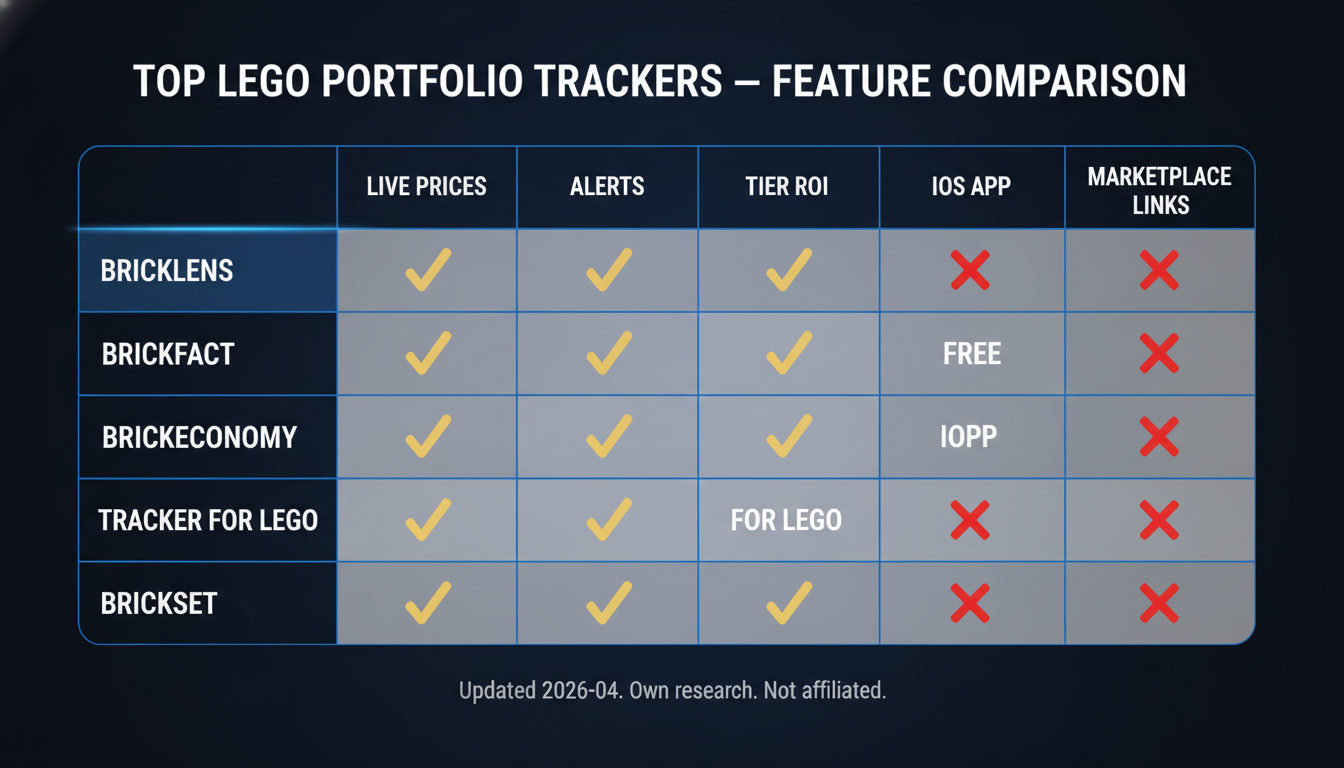
We evaluated the five most-recommended tools against the 5 metrics above plus three workflow features (live prices from multiple marketplaces, price alerts, and native iOS app). Our ranking:
BrickLens (us) — iOS, freemium
What it does well: Live BrickLink + eBay + BrickOwl prices, per-set ROI projections grounded in HSE tier multipliers, price alerts, sealed-vs-opened basis tracking. Built specifically for portfolio-level views.
What it doesn't: No Android app yet. Free tier is capped at 10 lookups/month.
Who it's for: Investors who want all 5 metrics in one iOS-native app with real-time marketplace prices.
BrickEconomy — web, free + paid
What it does well: Best-in-class individual set price history. Full secondary-market depth. Portfolio feature exists and is serviceable.
What it doesn't: No tier-level ROI roll-ups, no alerts without the paid tier, no condition-decay model. The portfolio page is a list, not a dashboard.
Who it's for: Collectors who want the deepest single-set price history and will roll their own portfolio math.
Brickfact — iOS + Android + web, freemium
What it does well: Clean multi-platform UI, collection cataloging, lifetime tracking. Strong for cataloging.
What it doesn't: Price accuracy lags 1-2 weeks on less-liquid sets, no tier-level analytics, no net-of-fees calculation.
Who it's for: Cataloguers who want a polished pan-platform experience and don't need live marketplace depth.
Tracker for LEGO — iOS only, paid
What it does well: Set lookup is fast. Clean UI.
What it doesn't: No live marketplace prices — uses Rebrickable data which is a parts database, not a price feed. No ROI, no alerts.
Who it's for: Collection cataloguers, not investors.
Brickset Collection — web, free
What it does well: Largest community, huge set database, works well as a catalog.
What it doesn't: Tracking is volunteer-maintained valuation data — fine as a ballpark, not ready for portfolio-grade decisions. No alerts, no tier analytics.
Who it's for: Free cataloging with rough-ballpark value. Not an investor tool.
The honest take
No tool is perfect. BrickLens is the only one that scored on all 6 features in our evaluation — but we built it, so take that with appropriate salt. If you disagree, our recommendation is: pick the tool that lets you input your actual basis and see net-of-fees portfolio P/L at tier level. Anything less is a price checker.
The 6-step portfolio workflow
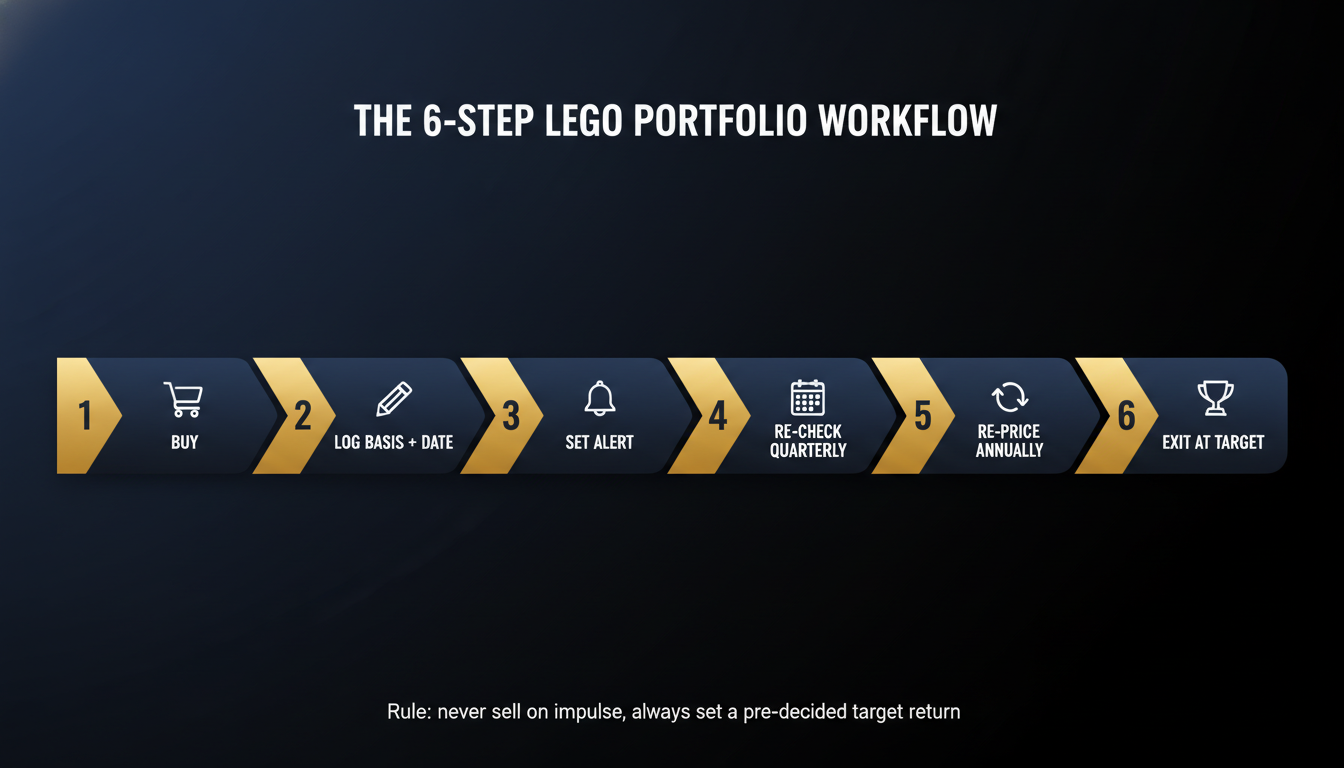
Whatever tool you land on, the workflow is the same:
1. Buy. Either retail while a set is still in production (captures the retirement premium later), or on the secondary market at a dip (skip the retail layer, catch the supply-freeze premium directly).
2. Log basis + date the day the set arrives. Purchase price, shipping, tax, purchase date, and photos of the sealed corners. If you can't do this step within 48 hours, the effort isn't going to survive a 5-year hold — go simpler.
3. Set a price alert at your target exit. We recommend 2× basis as a default first alert for sealed UCS, 1.5× for Modulars and Ideas, and 1.3× for Icons. Adjust by tier over time.
4. Re-check quarterly. Don't re-check weekly — LEGO secondary market moves too slowly for that to be signal. Quarterly is the right cadence. Update current-value estimates; don't react.
5. Re-price annually. Once a year, do a proper re-valuation using BrickEconomy median sold + eBay last-90-days median. Update your tracker with the true net-of-fees current value. This becomes your "if I had to liquidate today" portfolio number.
6. Exit at target — not before, not later. When a set hits its pre-decided exit price, list it. Do not "ride it higher." The behavioral failure mode of LEGO investing is holding winners too long into theme-cycle reversals. Pre-commit to the exit, or you will hold a 2x set all the way back down to 1.5x.
The 3 tracking mistakes that kill returns
Mistake 1: Not logging basis. Impossible to calculate ROI without it. If you bought the set 4 years ago and can't find the receipt, use the LEGO.com retail price at launch as a proxy — but only if it was a retail purchase.
Mistake 2: Confusing gross listed value with realized value. A portfolio "worth $50K on BrickEconomy" that costs $7.5K in fees and shipping to actually sell is worth $42.5K. Track realized.
Mistake 3: No concentration view. A 40-set portfolio that's actually 30 Star Wars UCS + 5 Marvel + 5 City is a Star Wars UCS bet. Good trackers show concentration by tier and by licensed IP. Rebalance when a single tier exceeds 40%.
What BrickLens does differently
Three things we bet the product on:
Per-set ROI projections based on HSE tier multipliers, not generic "price went up" graphs. When you plug in your basis, we tell you the expected 5Y and 10Y value for that specific set given its tier's historical return profile.
Alerts on net-of-fees price movement, not gross. You set the target in the dollar amount that would actually hit your bank.
iOS-native with background price monitoring. The app checks your alert thresholds every 6 hours without you opening it — the difference between catching a dip and missing one.
If that's the workflow you want, [download the iOS app](/#download) and try the 10-lookup free tier. If it's not, one of the other tools above probably is — the point of this post isn't to funnel you into BrickLens, it's to make sure you pick a *tracker*, not a *price checker*.
Bottom line
A LEGO portfolio tracker is a behavioral tool more than an information tool. It works when it forces you to log basis before you forget, to see P/L net of fees so you don't hallucinate returns, and to exit on a pre-set target so you don't hold winners into reversals.
Pick whichever tool lets you do those three things. If you're curious about the math behind the projections — our [investment calculator](/tools/investment-calculator) shows the tier-multiplier methodology in full. If you want the deeper investing case first, start with [is LEGO a good investment](/blog/is-lego-a-good-investment) and [the real LEGO appreciation rate](/blog/lego-appreciation-rate).