LEGO Polaroid Camera Set 21345: Build Review, Price, and 2026 Investment Outlook
"LEGO Polaroid" gets 6,600 monthly searches — more than "LEGO Titanic cost" (260/mo), more than "LEGO Eiffel Tower" (1,300/mo), and comparable to the search volume of much larger flagship sets. That is not because the LEGO Polaroid is a large or expensive set: it retails at $79.99 with only 516 pieces. It is because the Polaroid OneStep SX-70 Camera has crossed from LEGO product into cultural reference point.
Sets that become cultural references tend to perform exceptionally well as LEGO investments. This is exactly the collector-demand profile the LEGO Ideas theme was built around.
What set 21345 is
The LEGO Ideas Polaroid OneStep SX-70 Camera (set 21345) was released on January 1, 2024 under license from Polaroid Corporation. It is a replica of the SX-70 — the folding instant camera that Polaroid introduced in 1972 and sold through the early 1980s. The original SX-70 was the first mass-market camera to produce instant, self-developing color photographs using a bellows-fold design that collapsed flat for pocket storage.
The LEGO model replicates the SX-70 at approximately 1:1 scale with:
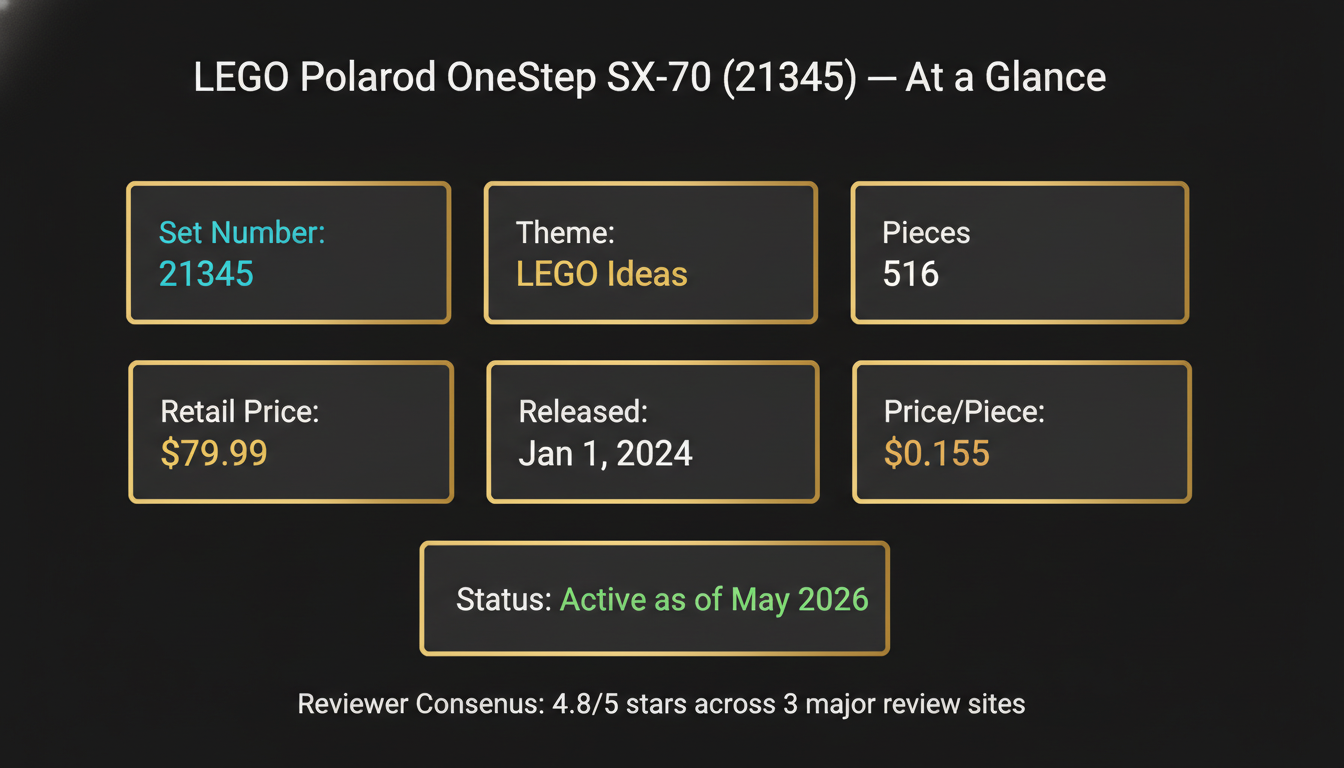
Piece count: 516 pieces
Theme: LEGO Ideas
Retail price: $79.99 USD / £69.99 UK / €79.99 EU
Released: January 1, 2024
Price per piece: $0.155 per piece
Build time: approximately 1 to 1.5 hours for adult builders
Status: Active in production as of May 2026 (2+ years since launch)
The functional detail includes a working shutter that actuates an internal mechanism when pressed, a film door that opens, and a printed tile "photograph" that slides out of the camera body — all replicating the experience of shooting with the original. The folding design is display-only (the LEGO model does not physically collapse), but the fold lines and bellows detailing are present.
The real SX-70 and why it resonates
The original Polaroid SX-70 was not just a camera — it was a design milestone that changed how people thought about photography. Before it, instant cameras were bulky, industrial-looking objects. The SX-70 was slim, folded flat, came in chrome and tan leather, and looked like something from a science fiction film. Ansel Adams called it "the most significant camera developed since the original 35mm Leica." Andy Warhol used one as his primary camera. The format defined an entire aesthetic that resurfaced in the Instagram era and has stayed culturally relevant ever since.
That background explains the 6,600 monthly search volume for "LEGO Polaroid." The people searching are not just LEGO fans — they are Polaroid enthusiasts, vintage camera collectors, people who remember SX-70 photographs from their childhood, photography students who have studied its design, and general consumers drawn to the nostalgic aesthetic. This multi-community buyer profile is one of the key predictors of exceptional post-retirement LEGO appreciation.
Build review: what the community actually thinks
The LEGO Polaroid received near-unanimous praise at launch in December 2023.
BrickArchitect: "an amazingly detailed set and a beautiful piece for anyone's collection." Brick Banter: "an absolute gem. The replication is fantastic, the functionality is amazing, and it looks so good up on a shelf." Multiple YouTube reviewers within the first month of launch called it "the best LEGO set of 2024." Reddit's r/lego had a thread from January 1, 2024 — the release date — where the top-voted comment read "so far, IMHO, the best set of 2024" before the year had even started.
The lone consistent criticism: at 516 pieces for $79.99, the price-per-piece of $0.155 is on the high side. Average LEGO Ideas set pricing runs $0.12-0.15 per piece; the Polaroid is at the upper end. The defense: LEGO Ideas sets are inherently premium products — licensed, adult-targeted, display-oriented, with unique printed elements — and the Polaroid's printed "photo" tile, chrome-effect pieces, and working mechanism justify the slight premium. The overwhelming buyer consensus, judging by review scores and resale demand, is that the experience is worth it.
One minority Reddit thread (January 2024) argued the set offered "few interesting pieces for parts-builders and limited display value." That view turned out to be a distinct minority: sales have remained strong two-plus years into the production window, and the secondarymarket has not shown any of the early-markdown signals that indicate low demand.
Where to buy and what it actually costs right now
As of mid-2026, the LEGO Polaroid OneStep SX-70 is available at:
LEGO.com: $79.99 (full retail)
Target, Amazon, select retailers: $75.99-79.99 (occasional discounts)
Best current price: approximately $75.99 across comparison engines
eBay (used, opened): $30-50 for opened or incomplete sets
BrickLink (sealed, new): at or near retail — no meaningful secondary premium yet
That last point is critical for investors: sealed copies are trading at or near retail with no secondary premium. The market has not yet priced in any investment thesis for this set. That is the optimal entry window — paying retail before the market prices in post-retirement appreciation. Once a set develops a secondary premium, you have already missed the ideal entry.
The LEGO Ideas investment thesis
LEGO Ideas is the third-highest-performing LEGO investment theme, behind only UCS Star Wars (17.6% annual post-retirement return) and Modular Buildings (15.4%). The Ideas average is 14.3% annually post-retirement, derived from the HSE 2022 study and post-2015 BrickEconomy tracking.
Three structural reasons Ideas outperforms:
The voting mechanism pre-builds the collector base. Every Ideas set required a fan vote before LEGO approved production. Before the set even ships, tens of thousands of people have signaled "I want this." That pre-existing demand guarantees a committed initial buyer pool the moment production stops and supply freezes.
Licensed nostalgia attracts cross-community buyers. Ideas sets based on cultural icons — the NASA Saturn V, Polaroid cameras, the Ship in a Bottle, the International Space Station — draw buyers from outside the traditional LEGO collecting community. The Polaroid specifically reaches vintage camera collectors, photography enthusiasts, and Polaroid nostalgia buyers who would not otherwise shop for LEGO. Multi-community demand widens the eventual buyer pool during the post-retirement appreciation period.
Tight production windows. Ideas sets tend to have shorter production runs than mainstream LEGO themes because the community-vote origination model limits how many get approved per year. Shorter production windows mean faster supply exhaustion after retirement, which compresses the timeline from "retired" to "significant appreciation."
Historical LEGO Ideas performance
The precedents are consistently strong:
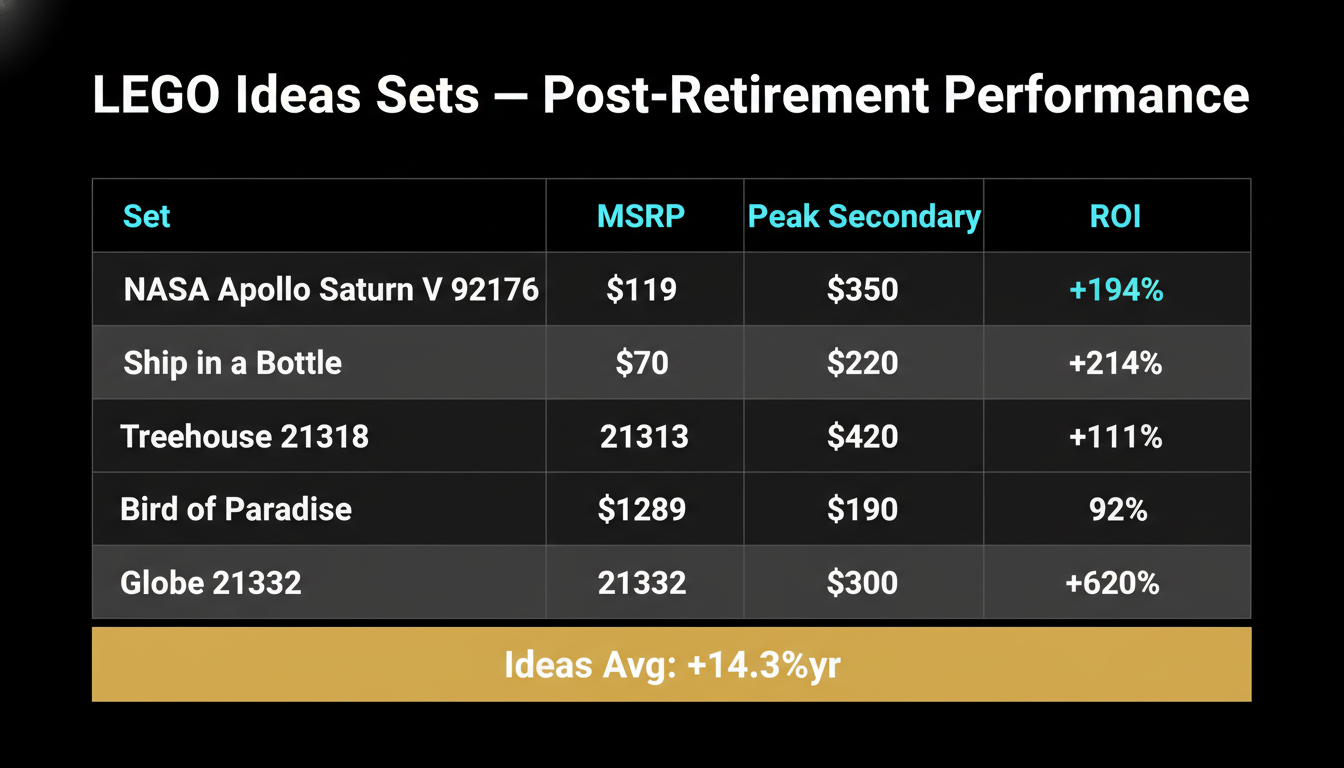
| Set | MSRP | Current Secondary | Return |
|---|---|---|---|
| NASA Apollo Saturn V 92176 | $119.99 | $350+ | +192% |
| Ship in a Bottle 21313 | $69.99 | $220+ | +214% |
| Treehouse 21318 | $199.99 | $420+ | +110% |
| Bird of Paradise 10289 | $99.99 | $190+ | +90% |
| Globe 21332 | $199.99 | $320+ | +60% |
The range — 60% to 214% cumulative return — reflects both the varying appeal of different Ideas sets and different hold periods. The Globe is relatively recent (2022), so its 60% gain represents a shorter appreciation curve. Ship in a Bottle and NASA Saturn V have had 5-8 years to compound from low-popularity starting points to well-established collector status.
The Polaroid sits in a category closer to Ship in a Bottle than the Globe: cross-community nostalgia appeal, strong design fidelity to a culturally significant original, and an audience that skews older (i.e., buyers with more disposable income). If the Polaroid follows the Ship in a Bottle pattern rather than the Globe pattern, the upper-range return projection of 150-200% cumulative over 7-10 years is not unreasonable.
The 2026 investment projection for set 21345
BrickEconomy's specific projection for set 21345: "close to 6% annual growth after the second year, valuing the set between $95 and $99 shortly after it is retired."
That 6% is the conservative baseline for a currently-active Ideas set. It represents the scenario where the Polaroid performs in the lower half of the Ideas range — broadly appreciated but not a breakout like Saturn V or Ship in a Bottle.
Working through three projection scenarios:
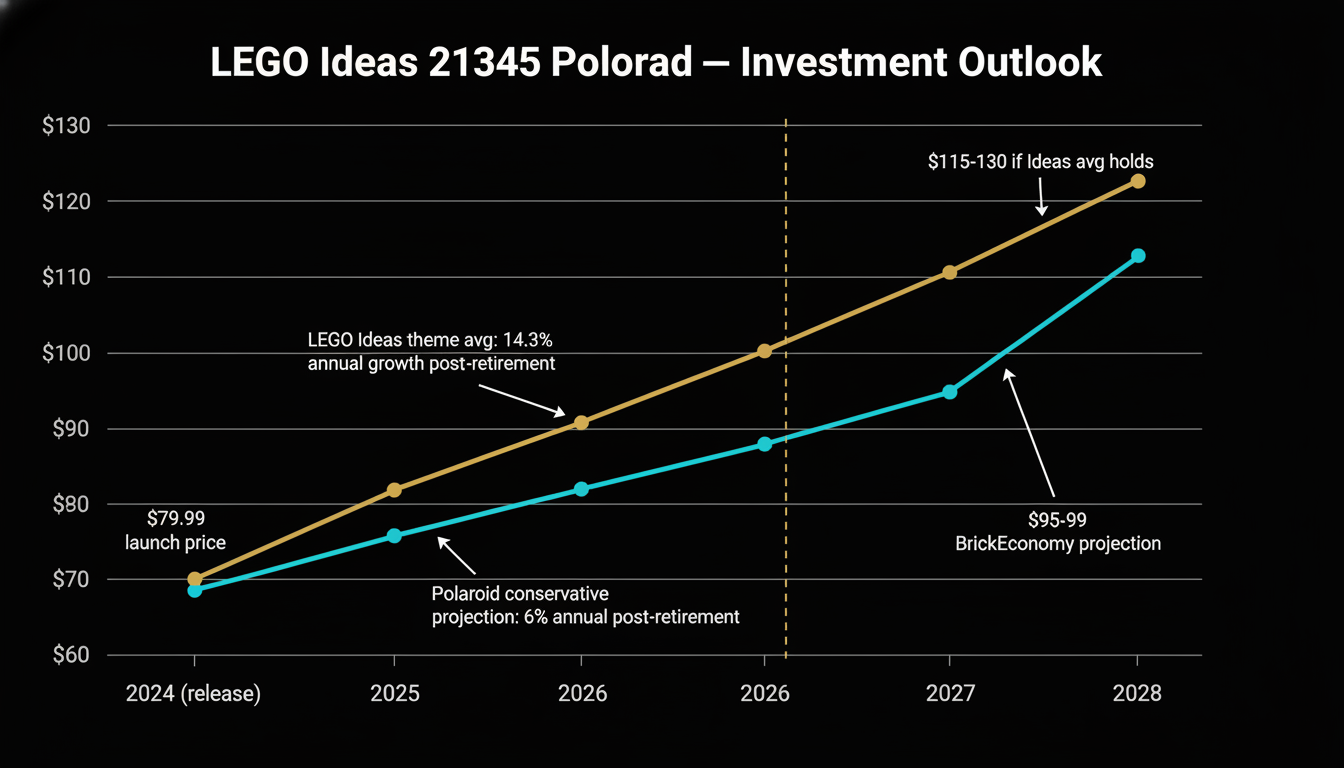
Conservative (6% annually, lower Ideas range):
Entry: $79.99 at retail
Year 2 post-retirement: $95-99
Year 5 post-retirement: approximately $107-112
After eBay + shipping at $107 exit: net approximately $86
Net annualized return from $79.99 purchase: approximately 5.5%
Mid-range (14.3% annually, Ideas theme average):
Year 5 post-retirement: approximately $155
After fees at $155 exit: net approximately $123
Net annualized return: approximately 10.5%
Upper range (resembles Ship in a Bottle trajectory):
Year 7 post-retirement: approximately $200-220
After fees at $200 exit: net approximately $158
Net annualized return: approximately 10-11%
The key uncertainty is which part of the Ideas range the Polaroid occupies. Multi-community appeal (Polaroid fans + LEGO fans) argues for the upper range. The shorter build time and relatively low piece count argues for the conservative range (less impressive as a pure LEGO build, may attract fewer completion-focused collectors). Our read: mid-range at 14.3% annualized is the most likely outcome, with real upside if the Polaroid nostalgia cycle stays elevated over the next decade.
When will it retire?
LEGO Ideas sets typically run 2-4 years in production. With a January 2024 launch and the set still in active production as of May 2026 (2 years and 5 months), retirement could come as early as late 2026 or as late as 2027-2028.
The right preparation: monitor LEGO.com stock status for 21345. "Low quantity" or "while supplies last" signals typically precede retirement by 2-4 months. At that point, sealed copies on the secondary market will jump immediately as last-minute investors enter the market. Buying at that point means paying someone else's expected retirement premium. Buy now, at retail, while it is still available without premium.
Should you buy, build, or hold for investment?
Buy to build: Yes. $79.99 for a display piece that earns consistent 4.8+ star reviews, has working mechanical interest, and looks immediately recognizable to any non-LEGO guest in your home. Strong value. Go ahead.
Buy to display: Yes. The Polaroid photographs exceptionally well and functions as a conversation piece for non-LEGO audiences. It reads as "interesting vintage replica" to most people before it reads as "LEGO set." That is rare.
Buy one copy to build, keep a second sealed: Optimal. This is the structure any serious LEGO investor uses for sets they genuinely like. Build and display one copy; seal and store the second. The sealed copy captures the investment return. The built copy delivers the enjoyment. The capital efficiency is higher than buying two purely sealed copies because the built copy depreciates to display value rather than sitting as idle capital.
Buy sealed only, for investment: Yes, but only at retail. At $79.99, no secondary premium, LEGO Ideas theme track record, and the specific cultural profile of this set: the case is strong. Hold 5-7 years post-retirement. Do not buy opened sets on eBay and expect investment returns — the seal premium is the entire investment thesis.
Do not buy on BrickLink at secondary-market prices equal to or above retail for pure investment. There is no pricing advantage over buying directly from LEGO.com.
To project your specific hold period against the Ideas tier model, use the [LEGO Investment Calculator](/tools/investment-calculator). For context on how Ideas sets fit the full LEGO investment landscape and the fee math that determines real returns, see [LEGO Investment Guide 2026](/blog/lego-investment). For portfolio-level tracking once you have multiple sets, see [How to Track Your LEGO Collection Value](/blog/how-to-track-money-spent-on-lego).
The bottom line
The LEGO Polaroid OneStep SX-70 Camera (set 21345) is $79.99 at retail, 516 pieces, released January 2024, and sits in the LEGO Ideas theme — which averages 14.3% annual post-retirement appreciation. It is currently trading at or near retail with no secondary premium, which means the entry price is optimal for investors.
BrickEconomy's conservative projection: $95-99 shortly after retirement (6% annually). The Ideas theme average suggests $135-155 by year 5 post-retirement, netting approximately 10% annually after fees. The Ship in a Bottle analogy (shared nostalgia-crossover appeal) suggests the upper range is achievable over a 7-8 year hold.
As a build: excellent, near-universally praised, $79.99 well spent.
As an investment: buy at retail now while there is no secondary premium. Seal it. Hold 5-7 years post-retirement. The LEGO Ideas track record, the cross-community Polaroid nostalgia appeal, and the current pricing make this one of the stronger mid-range LEGO investment opportunities available in 2026.