LEGO Investing 101: The Beginner's Getting-Started Guide (2026 Edition)
"LEGO investing" pulls about 720 monthly searches with a keyword difficulty of 15 — moderate competition because the topic has been covered, but most coverage is either (a) "is LEGO a good investment?" content that answers the philosophical question without walking the actual mechanics, or (b) brick-flipping content that focuses on short-term arbitrage rather than portfolio construction.
This guide is the missing piece: an end-to-end getting-started playbook for someone who has decided LEGO investing might be worth trying and wants to understand the prerequisites, the tier framework, the starter portfolio composition, and the predictable failure modes — all grounded in the 2022 Higher School of Economics study (11% baseline annualized return across 2,322 retired sets, 1987-2015) and the 2026 BrickEconomy + BrickLink sold-listings data.
If you want the philosophical "should I bother" answer first, read [is LEGO a good investment](/blog/is-lego-a-good-investment). This guide assumes you've already decided "yes, maybe" and want to know "okay, how exactly do I start."
Step 1: Verify the 4 prerequisites
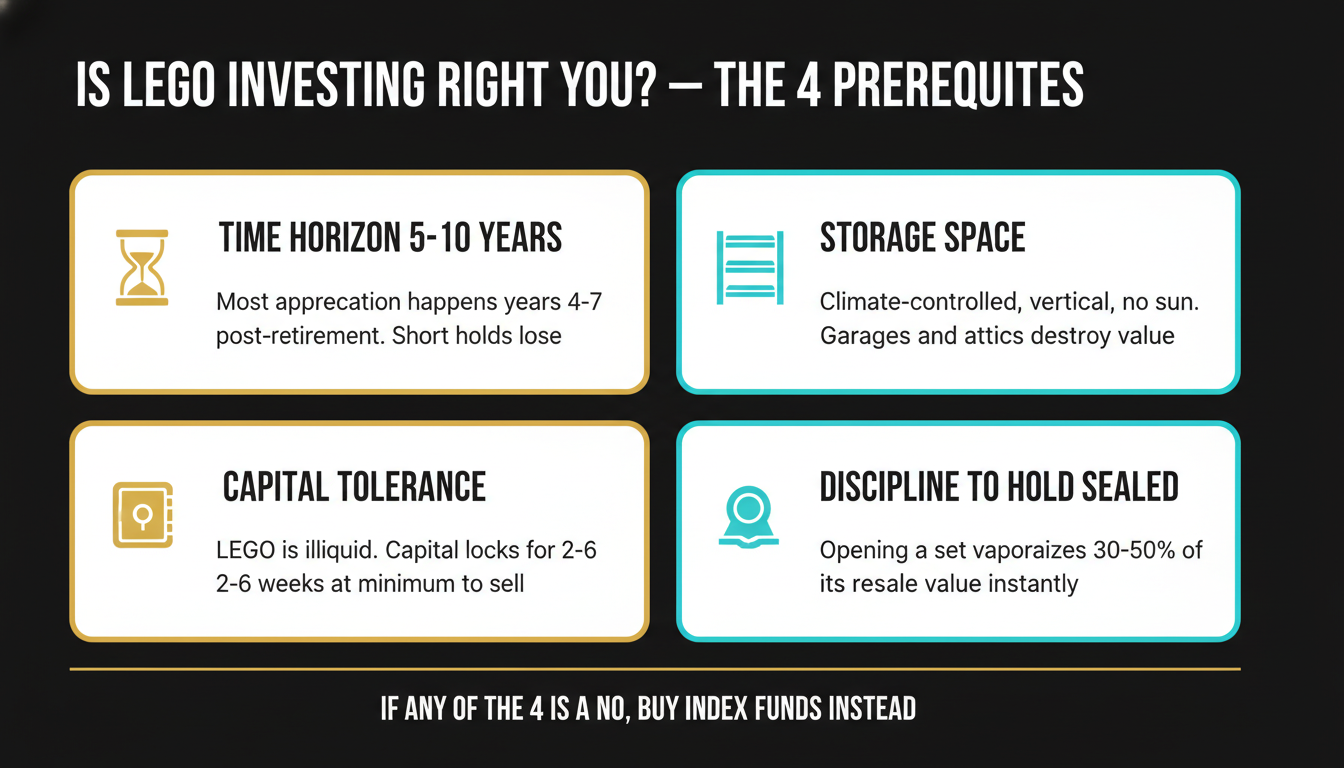
LEGO investing requires four prerequisites. If any are a no, buy index funds instead — the friction will eat your returns.
Prerequisite 1: Time horizon of 5-10 years minimum
The HSE 2022 data is clear: most retired-LEGO appreciation happens between years 4 and 7 post-retirement. Sets sold in years 1-3 underperform their lifetime appreciation by roughly 50%. If you need capital back within 3 years, LEGO is the wrong asset class — index funds and high-yield savings have meaningfully better short-horizon risk-adjusted returns.
A reasonable LEGO investment hold is 7-10 years from purchase, with a "set the price alert at your target exit" cadence rather than a "monitor daily" approach.
Prerequisite 2: Climate-controlled storage space
Box condition matters enormously for LEGO resale — sealed-with-corner-creases sells for 25-30% below sealed-mint, and humid/sun-exposed boxes can drop another 20-30% from there. The minimum storage standard is:
Climate-controlled — temperature 60-75°F, humidity below 60%
Vertical — boxes stored upright like books, not stacked horizontally (stacking crushes corners)
No sun — closets and interior shelves only, never near windows
Single-layer — boxes touching each other is fine, boxes piled on top of boxes is not
A typical 4-shelf bookcase in an interior closet handles 50-80 sets comfortably. If you don't have this space, your effective returns will be 30-50% below the projections in this guide.
Prerequisite 3: Capital tolerance for illiquidity
LEGO is illiquid. From "decide to sell" to "money in bank" runs 2-6 weeks at minimum — listing, photographing, packing, shipping, dealing with returns, payment processing. Anyone selling LEGO into a cash crunch will accept worse prices.
The capital you deploy into LEGO investing should be capital you wouldn't otherwise need within 2-5 years. Treat it like a 5-year CD with materially better expected return and materially worse liquidity.
Prerequisite 4: Discipline to hold sealed
The single highest-impact decision in LEGO investing is to never open the box. Opening a sealed set vaporizes 30-50% of its resale value instantly. The temptation is real — collectors who like LEGO want to build LEGO — but collect-for-display and collect-for-return are fundamentally different decisions.
If you can't hold sealed for 7-10 years, either (a) buy two copies of every set, sealed one and built one, or (b) accept that "investing in LEGO" effectively means doubling your basis to capture the seal premium on the held-sealed copy.
If all four prerequisites are yes, proceed. If any is no, the friction will erode your expected returns to the point where simpler asset classes (index funds, gold ETFs, REITs) deliver better risk-adjusted returns with less storage and selling friction.
Step 2: Learn the 9 tier multipliers
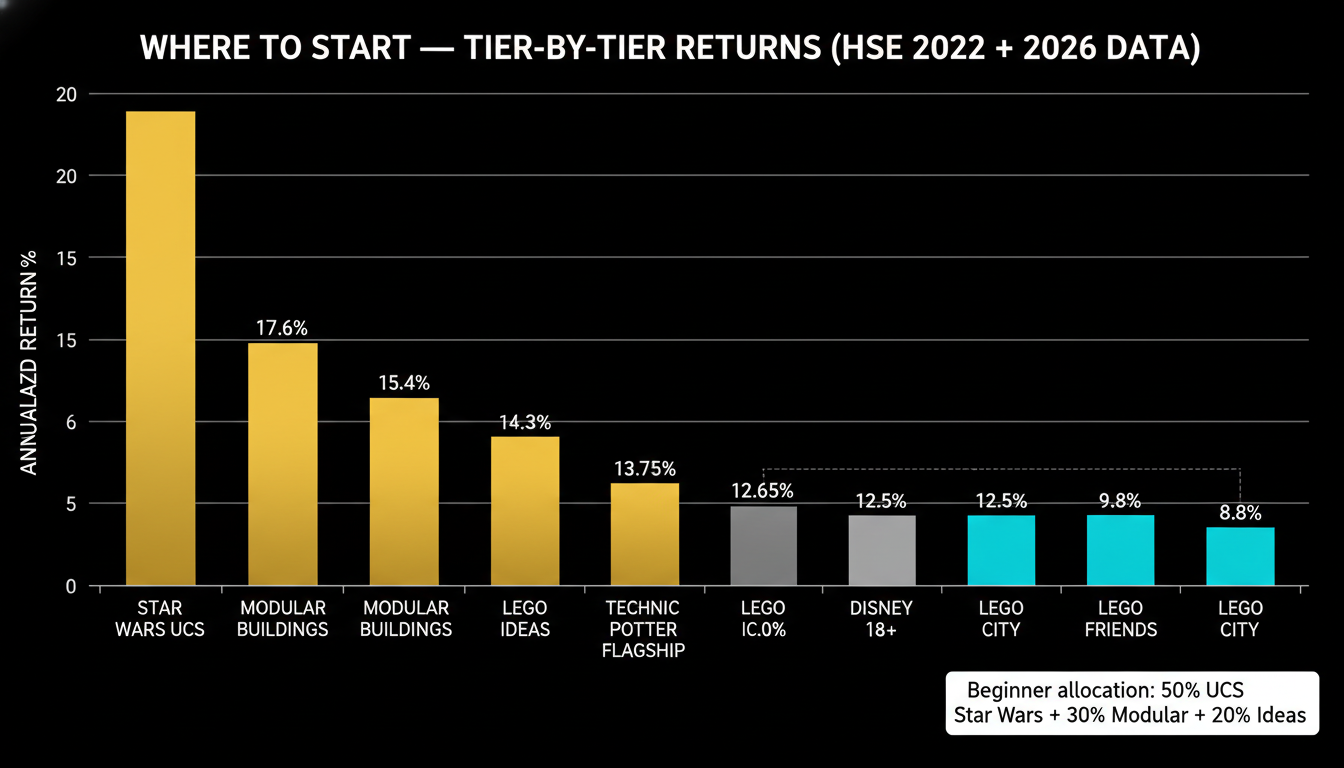
Not all LEGO is equal. The tier multipliers determine 60-70% of any individual set's expected return:
| Tier | Annualized return | Best examples |
|------|-------------------|---------------|
| Star Wars UCS flagships | **17.6%** | 75192 Millennium Falcon, 71043 Hogwarts Castle |
| Modular Buildings | **15.4%** | 10182 Café Corner, 10297 Boutique Hotel |
| LEGO Ideas | **14.3%** | 21318 Tree House, 21348 D&D Red Dragon |
| Harry Potter UCS | **13.75%** | 71043 Hogwarts, 75978 Diagon Alley |
| Technic flagship supercars | **12.65%** | 42143 Ferrari Daytona, 42115 Lamborghini |
| Disney 18+ flagships | **12.5%** | 71040 Disney Castle, 43269 101 Dalmatians |
| **LEGO baseline (HSE 2022)** | **11.0%** | The unweighted average |
| LEGO City | 9.35% | Below baseline — avoid |
| LEGO Friends | 8.8% | Lowest of major themes — avoid |
The math: a $500 set in the UCS Star Wars tier (17.6%) becomes $1,130 in 5 years and $2,550 in 10 years. The same $500 in LEGO City (9.35%) becomes $780 in 5 years and $1,200 in 10. The tier choice alone is a 2x difference in expected outcomes.
The actionable rule: 80%+ of your LEGO portfolio should be in the top 5 tiers (UCS Star Wars, Modular Buildings, Ideas, Harry Potter UCS, Technic flagship). Allocations to City, Friends, and standard licensed-Star-Wars sets are either pure collecting (fine — just not investing) or mistakes (driven by emotional rather than data-driven selection).
We covered the full tier framework with more nuance in [the LEGO appreciation rate analysis](/blog/lego-appreciation-rate).
Step 3: Build the $1,000 starter portfolio
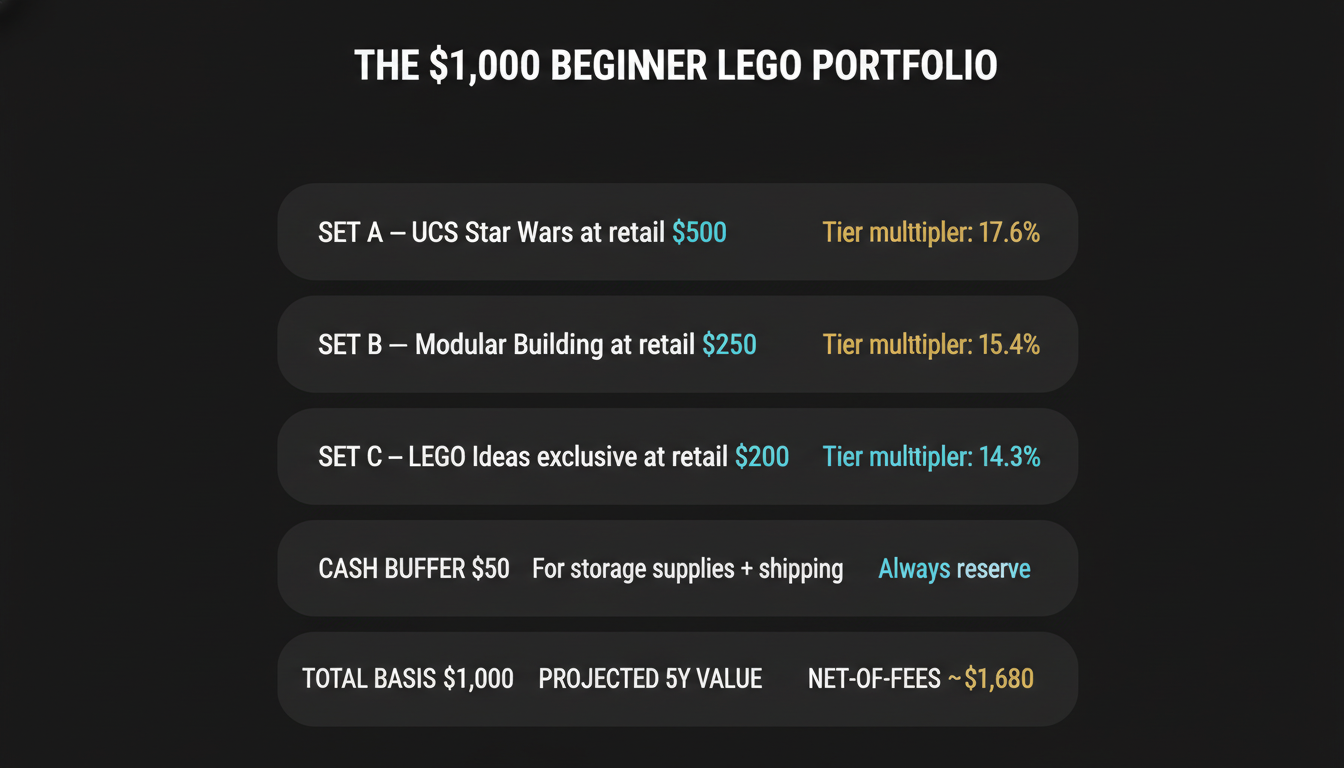
For a beginner with $1,000 of capital, here's a defensible allocation:
| Set type | Allocation | Example | Expected 5Y |
|----------|-----------|---------|-------------|
| UCS Star Wars at retail | $500 (50%) | 75192 Millennium Falcon at $850 — buy used-sealed or wait for sale | ~$1,100 |
| Modular Building at retail | $250 (25%) | 10326 Natural History Museum at $299.99 — buy on dip below $250 | ~$510 |
| LEGO Ideas exclusive | $200 (20%) | 21348 D&D Red Dragon at $359.99 — buy on dip below $200 | ~$390 |
| Cash buffer | $50 (5%) | Storage supplies, shipping materials | reserve |
| **Total** | **$1,000** | | **~$2,000** |
Projected 5-year gross value: ~$2,000. Net of eBay/PayPal fees (16% drag) and shipping ($30-$45 per set sold) on hypothetical liquidation: ~$1,680. That's a 68% net return over 5 years, or about 11% annualized after fees. Above the broader US stock market over comparable periods, with materially different liquidity profile.
A few caveats on this portfolio:
The retail prices listed are aspirational. UCS Millennium Falcon at $850 is not literally available at retail — secondary market is $1,100+ as of 2026. Realistic execution requires patience for sale windows (covered in [the LEGO deals guide](/blog/lego-deals-guide)) or accepting modest secondary-market premiums.
The "expected 5Y" numbers assume tier-average returns. Individual set performance ranges from -10% (poor pick, unlucky theme cycle) to +200% (strong pick, favorable IP timing). The starter portfolio is constructed to average toward the tier multipliers, not to maximize any single bet.
The portfolio is concentrated in Star Wars UCS. This is a deliberate choice for beginners — UCS Star Wars is the most reliable tier historically. As you scale to $5,000+ portfolios, diversifying across more tiers becomes important. We walked the $5,000 portfolio composition in [best LEGO sets to invest in 2026](/blog/best-lego-sets-to-invest-in-2026).
Step 4: Execute the buy workflow
For each set you decide to buy:
1. Verify the tier multiplier. Cross-reference the set's tier against the table above. If the set isn't in a top-5 tier and you're buying it for return, reconsider.
2. Check the secondary-market price floor. BrickEconomy and Brick Ranker show current sealed-market data. Don't pay more than 10% above the current secondary-market sealed price; if the set is at retail, that's almost always the best entry.
3. Buy from the right channel. Retail: LEGO.com (for exclusives + VIP rewards), Amazon (for non-exclusives + Subscribe & Save), Target (for RedCard + Circle stacking). Secondary: BrickLink (transparent pricing), eBay (largest inventory, careful with seller verification).
4. Log basis the day the set arrives. Purchase price (including tax + shipping), purchase date, photos of sealed corners. This basis-recording is the single most important non-buying action you take — without it, you can't calculate ROI later, and 5 years from now you won't remember.
5. Set a price alert at your target exit. Default: 2x basis for sealed UCS Star Wars, 1.5x basis for Modular, 1.3x basis for Ideas/Harry Potter. [BrickLens](/) handles automatic alerts; manual alternative is BrickLink's price tracker.
6. Store properly. Climate-controlled, vertical, no sun, single-layer. The day-1 storage decision determines 30-40% of your eventual realised return.
The full per-set workflow is in [the LEGO portfolio tracker playbook](/blog/lego-portfolio-tracker).
The 6 mistakes that wreck new LEGO investors
Mistake 1: Opening sealed sets. Single highest-impact mistake. Vaporizes 30-50% of resale value. Always buy two copies (one for display, one sealed for investment) or accept that you've become a builder, not an investor.
Mistake 2: Buying City or Friends as "investments." Below-baseline tiers will not beat alternatives. If you're collecting City/Friends for personal use, fine — but don't pretend they're investments.
Mistake 3: Selling sets in years 1-3 post-retirement. Leaves 50-100% of lifetime appreciation on the table. The HSE data is clear: the appreciation curve is steepest at years 5-7.
Mistake 4: Ignoring transaction costs. eBay 13% + PayPal 3% + shipping = ~17% effective drag. Your "I sold it for $1,000" experience nets ~$830. Always model net-of-fees when projecting returns.
Mistake 5: Storing sets in attics, basements, or garages. Humidity, temperature swings, sun exposure all destroy box condition. 30-50% of potential return lost to bad storage.
Mistake 6: Selling out of FOMO during downturns. LEGO doesn't have daily price quotes the way stocks do — it's harder to panic-sell. But individual set price drops do happen (theme-cycle reversals, broader collectibles market downturns). Holding through these is non-negotiable for tier-average returns.
Tools to set up Week 1
Three tools to install in your first week of LEGO investing:
[BrickLens iOS app](/) — barcode scan any set to add to portfolio, get live BrickLink + eBay + BrickOwl prices, set price alerts on individual sets, view per-set ROI projections. Built for the workflow above.
BrickEconomy account — primary source for set-specific pricing data. Free tier shows current value; paid tier adds historical sold data and portfolio tracking. The canonical reference for any specific set's price history.
[Investment calculator](/tools/investment-calculator) — input any set's purchase price, holding period, and tier. Returns projected 5Y/10Y values with tier multiplier applied. Useful for "should I buy this specific set?" decisions.
Bottom line
LEGO investing works when the 4 prerequisites (time horizon, storage, capital tolerance, sealed-hold discipline) are all yes and the 9 tier multipliers guide selection. A $1,000 beginner portfolio in UCS Star Wars + Modular + Ideas projects to $2,000 gross / $1,680 net in 5 years — about 11% annualized after fees, which beats most fixed-income alternatives and matches the broader stock market with different risk characteristics.
The 6 mistakes (opening sealed sets, buying low-tier themes as investments, selling years 1-3, ignoring fees, bad storage, panic selling) are the predictable failure modes. Avoiding them is more than half the skill.
If you've decided LEGO investing is right for you, the actionable next step is: pick one set from the top-tier list, buy at retail or below secondary, log the basis, store properly. That's the start. Scaling from $1,000 to $5,000+ portfolios is covered in [best LEGO sets to invest in 2026](/blog/best-lego-sets-to-invest-in-2026); managing a multi-set portfolio is covered in [the LEGO portfolio tracker playbook](/blog/lego-portfolio-tracker); avoiding overpaying on deals is covered in [the LEGO deals guide](/blog/lego-deals-guide).
Related reading: [is LEGO a good investment](/blog/is-lego-a-good-investment), [the real LEGO appreciation rate](/blog/lego-appreciation-rate), [retired LEGO sets — what they are worth now](/blog/retired-lego-sets), [the LEGO portfolio tracker playbook](/blog/lego-portfolio-tracker).