Is LEGO a Good Investment? Real Data from 2,322 Retired Sets
Short answer: yes — but with caveats most "LEGO investing" content skips. The Higher School of Economics 2022 study analysed 2,322 retired LEGO sets sold between 1987 and 2015 and found an 11% nominal annual return on the average set. That beats the S&P 500 (10% over the same period) and gold (6.5%). On a risk-adjusted basis it beats both more decisively.
But "average" hides a 600-point spread. Some sets returned over 600%. Some lost 20%. The difference between a winning portfolio and a losing one is almost entirely about which sets you pick, how long you hold them, and whether you keep the seal intact.
This post walks the actual numbers, the risks, and the playbook we'd give to a friend asking whether to start collecting for return.
The headline study
Russian economists at HSE published [_LEGO: The Toy of Smart Investors_](https://www.sciencedirect.com/science/article/abs/pii/S1544612322002859) in mid-2022. They built a database of every LEGO set retired between 1987 and 2015, then tracked secondary-market prices on BrickLink and BrickPicker.
Headline finding: average annual return 11% nominal, beating the S&P 500 (10% nominal) and gold (6.5% nominal) over the same period. After adjusting for inflation, LEGO returned ~8% real vs the S&P's ~7%.
The kicker: LEGO did this with lower volatility than the S&P because retired-set prices respond to scarcity (a slow physical constraint), not quarterly earnings sentiment. The Sharpe ratio they calculated put LEGO ahead of every major asset class except a few exotic alternatives.

"Average" is doing a lot of work
The 11% figure is a portfolio-weighted average across 2,322 sets. Individual sets ranged from −20% to +600%+. The distribution looks like crypto: a handful of moonshots pulling the mean up, a long tail of sets that barely beat inflation, and a meaningful slice that lost money outright.
Three things separate winners from losers:
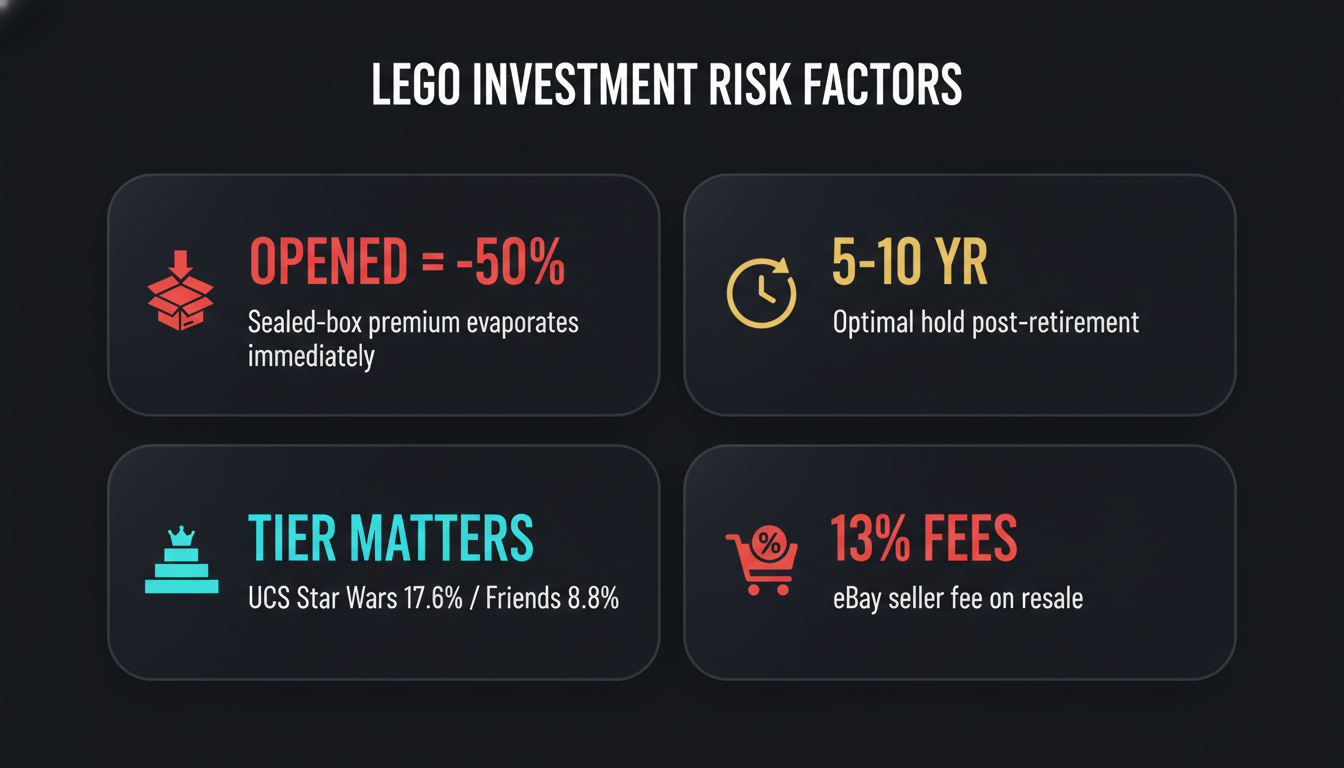
Theme tier. Star Wars UCS sets historically averaged ~17.6% annualized — 60% above the LEGO baseline. LEGO Friends averaged ~8.8% — 20% below. Same broad asset class, very different return profiles.
Time held. Sets sold in years 1–2 post-retirement often leave 50–100% of their lifetime return on the table. The supply curve takes 5–10 years to fully tighten.
Condition. A sealed set is a different asset to an opened one. The moment you break the seal, expect a 30–50% drop in resale value — even if every brick is pristine.
You can plug your own purchase price + holding period + tier into our [LEGO Investment Calculator](/tools/investment-calculator) to see how the numbers actually play out for a specific set.
Why retired LEGO appreciates at all
LEGO sells discrete, numbered sets that are produced for a defined window — usually 1 to 3 years — then permanently retired. Once production ends, supply is fixed forever. New collectors enter the hobby every year (the adult-fan-of-LEGO market has roughly tripled since 2015). Demand grows; supply doesn't. Price climbs.
Three quirks compound the effect:
Boxes don't survive. Cardboard ages, gets damp, gets crushed. The pool of mint-sealed copies shrinks every year through attrition.
Sets get displayed. Most buyers actually open theirs. That permanently removes them from the sealed market.
Themes go in and out of cultural cycles. A licensed Marvel set retired during a Marvel slump might wait years before its theme cycles back into demand.
This is a different return mechanism to stocks (earnings growth) or gold (monetary hedging). It's pure scarcity arithmetic, modulated by fashion.
The risks "LEGO investing is safe" videos don't talk about
Four real risks:
1. The 50% seal premium evaporates instantly
Open the box once and you've vapourised roughly half your potential resale value. This is the single biggest "return killer" for casual collectors who underestimate how strict the sealed-box premium is. You can't have it both ways: collect-for-display and collect-for-return are different decisions.
2. Storage destroys value
Humidity discolours boxes. Direct sunlight fades print. Stacking heavy sets crushes corners. A set that should sell for $1,200 sealed-mint sells for $800 sealed-but-corner-creased. Climate-controlled, vertical, single-layer storage is the bar. Most people store LEGO in attics, basements, and garages — all wrong.
3. Transaction costs eat returns
eBay takes 13% of the sale price from sellers. PayPal takes another 3%. Shipping a 4kg UCS set adds $30+. Net of fees, your "I sold it for $1,000" trip nets you ~$820 minus shipping. The Investabrick / BrickEconomy "current market value" numbers are the gross — never the net.
4. Time horizon is non-negotiable
LEGO is illiquid. You can't sell a sealed UCS Millennium Falcon at 2pm and have cash by 3pm. Listing, photographing, packing, shipping, dealing with returns — figure 2–6 weeks from "decide to sell" to "money in account" on a meaningful set. Anyone selling LEGO into a cash crunch will accept worse prices.
What the tier data actually says
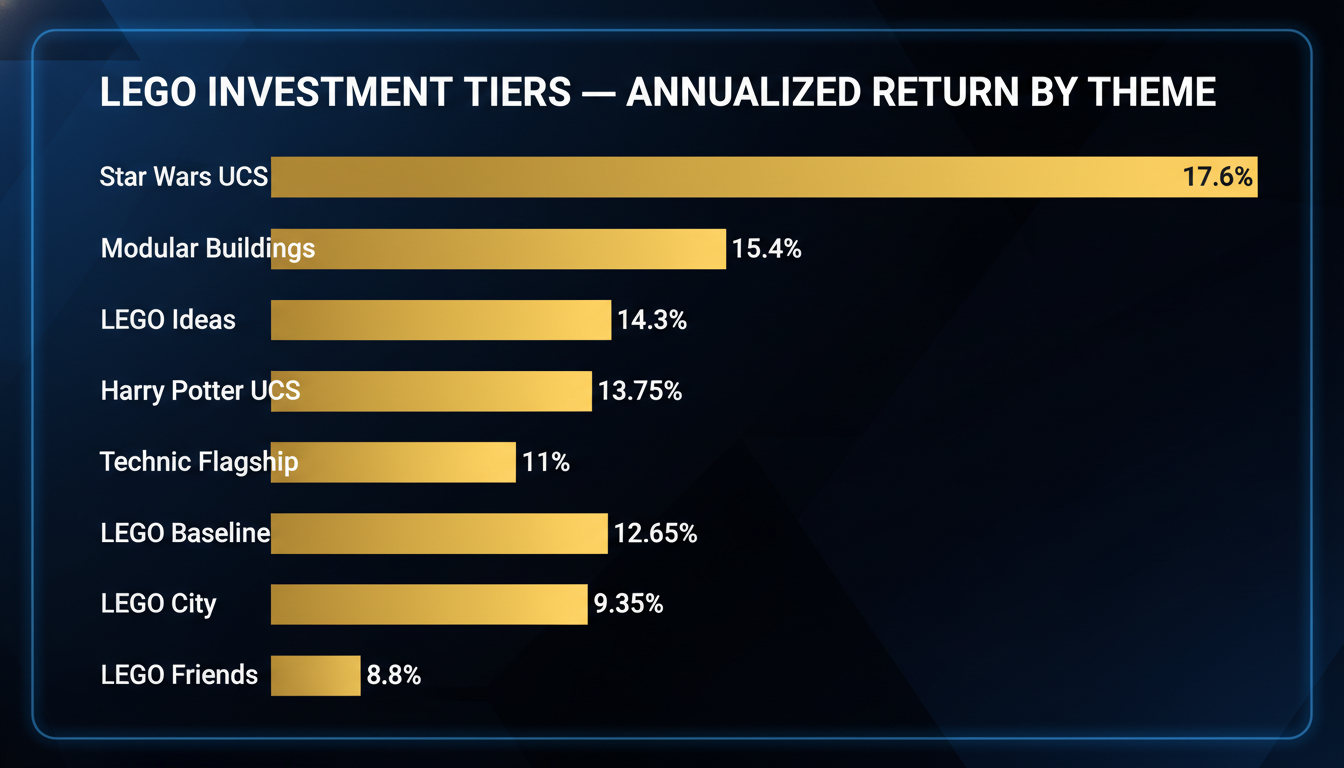
Pulling theme-level data from BrickEconomy + BrickLink sold listings (2010–2024 window for current-market relevance):
Star Wars UCS — 17.6% annualized. The strongest tier consistently. Anchored by 10179, 10221, 10212, and the 75192 / 75313 generation.
Modular Buildings — 15.4%. The "Café Corner" series from Creator Expert. Long retirement curves.
LEGO Ideas — 14.3%. Limited-production fan submissions. Tree House (21318), Sideways House, Steamboat Willie.
Harry Potter UCS — 13.75%. Hogwarts Castle (71043), Diagon Alley (75978), Gringotts (76417).
Technic flagship supercars — 12.65%. Bugatti Chiron, Lamborghini Sián, Porsche 911 GT3 RS.
General LEGO baseline — 11% (the HSE figure).
LEGO City — 9.35%. Mass-market themes underperform the baseline.
LEGO Friends — 8.8%. Lowest of the major themes.
Note: licensed themes are sensitive to IP cycles. A Star Wars set retired during a quiet Star Wars year (2017's slump after _The Last Jedi_, for example) often had a slow first 2–3 years before catching up to its tier average. Patience.
The realistic 5-set starter portfolio
If someone asked us how to spend $2,000 today on a portfolio with the highest expected return / risk profile based on the tier data:
| Set | Tier | Retail | Why |
|---|---|---|---|
| Hogwarts Castle (71043) | Harry Potter UCS | $469.99 | High piece count, beloved IP, expected to retire 2026 |
| Eiffel Tower (10307) | Icons | $679.99 | Largest set ever, scarcity story baked in |
| D&D: Red Dragon's Tale (21348) | Ideas | $359.99 | First D&D crossover, expected late-2026 retirement |
| Ferrari Daytona SP3 (42143) | Technic flagship | $399.99 | Ferrari licence + iconic shape |
| Boutique Hotel (10297) | Modular | $99.99 (used) | Already retired; modular curve compounding |
Total: ~$2,010. Expected blended annualized return based on tier weights: ~13.8%. Project that out at our [investment calculator](/tools/investment-calculator) and you're looking at ~$3,800 in 5 years and ~$7,300 in 10 — assuming you hold sealed.
The honest verdict
LEGO is a real asset class that has historically outperformed the S&P 500. It's also illiquid, condition-sensitive, theme-cyclical, and has 13–16% transaction-cost drag.
It works as a portion of a diversified portfolio — somewhere between collectibles and alternatives. The same way you'd hold gold or art. It does not work as a get-rich-quick play, and it definitely does not work if you're going to open every set you buy.
For a collector who already enjoys the hobby, "investing" is a tax on no-fun: you trade the joy of building for the option value of selling later. That's a personal trade-off, not a financial one.
For an investor with no emotional connection to LEGO, the historical numbers are good enough to justify a small allocation if you're willing to hold 7–10 years and tolerate the storage + selling friction.
How to get started without overthinking it
Pick one set in the Star Wars UCS, Modular, or Ideas tier that's currently in production but expected to retire within 12–18 months.
Buy from LEGO.com directly to lock retail price and double-VIP points.
Photograph the box, save the receipt, log it in a tracker (we obviously recommend [BrickLens](https://apps.apple.com/us/app/id6759543533)).
Store sealed, climate-controlled, vertical.
Wait 5–7 years post-retirement before considering selling.
Track market value monthly to know when scarcity has done its work.
That's the playbook. The tools to execute it cost nothing. The discipline to actually hold sealed for a decade is the rare part.