LEGO How to Train Your Dragon: The 10375 Toothless Investment Case (2026)
LEGO 10375 Toothless is one of the most interesting sets of the 2025 cohort, and the search data is telling the same story: "how to train your dragon lego" pulls about 10,500 monthly searches with a keyword difficulty of essentially zero — almost nobody has written about it properly because it shipped less than a year ago.
Here's the honest one-paragraph case: this is the first-ever LEGO How to Train Your Dragon set, it launched July 1, 2025 as a LEGO.com / LEGO Store exclusive at $69.99 USD, it's already trading at roughly $149 sealed on the secondary market eight months later (+113%), and the structural setup — exclusive distribution + movie tie-in + first-of-IP + LEGO Icons line — checks every box for above-baseline appreciation. The downside is that it's a small-budget set (784 pieces) in a tier (Icons) that historically returns around the 11% LEGO baseline, not a 17% Star Wars UCS multiple. So the question isn't "is it good," it's "how much of your LEGO budget should it be."
This post walks the specs, the three structural reasons this set is more interesting than the average LEGO Icons release, the live secondary-market trajectory, when to buy, and the risks that could compress the projection.
The 10375 Toothless — what you actually get
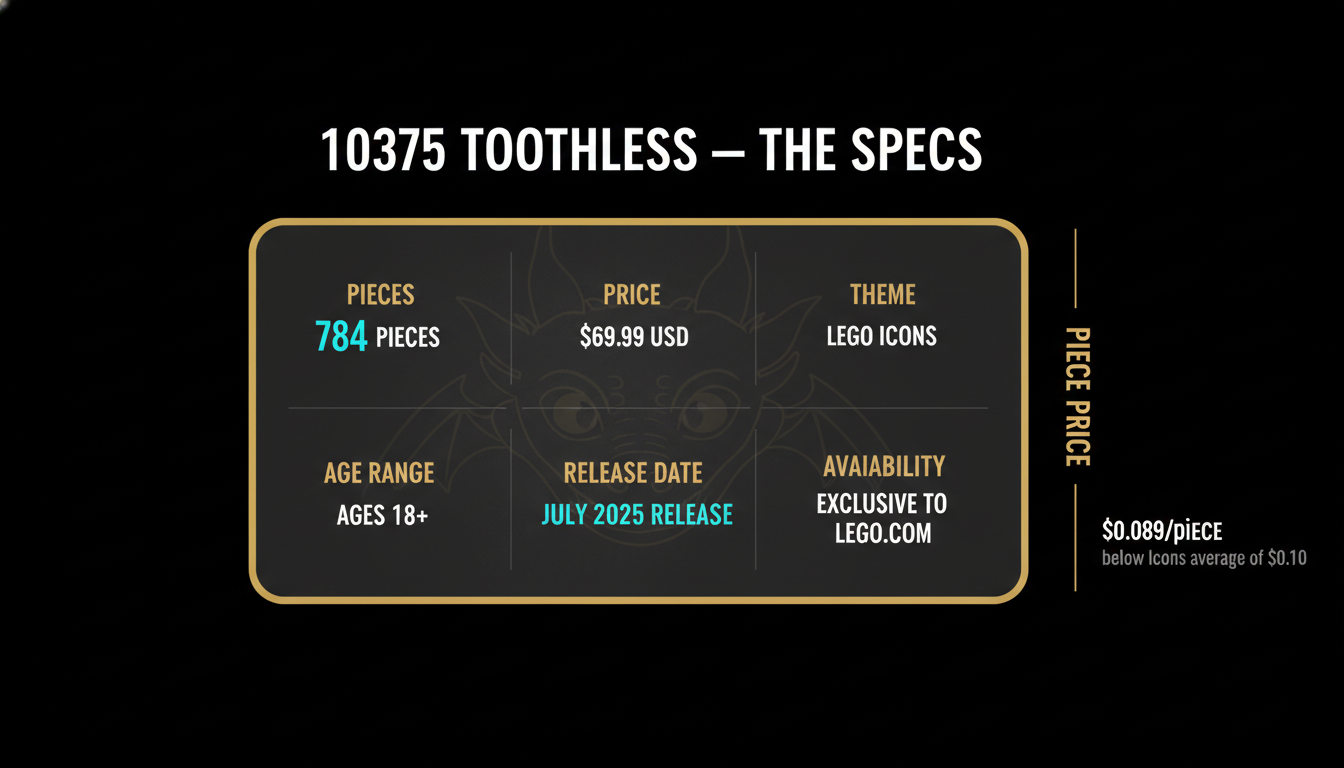
LEGO Icons 10375: How to Train Your Dragon — Toothless was officially announced June 2, 2025, with a release date of July 1, 2025, as a LEGO.com and LEGO Store exclusive. The headline specs:
784 pieces
$69.99 USD / £59.99 GBP / $89.99 CAD / $109.99 AUD retail
LEGO Icons line (18+ branding, "Adults Welcome" Display category)
Toothless figure stands ~6.5 inches (16 cm) tall, with poseable head, jaw, wings, and tail
Includes the iconic saddle, the repaired prosthetic tail fin, a fish accessory, and a plasma-blast accessory
No minifigures — this is a single-figure display set, like the LEGO Botanical Collection or LEGO Architecture skylines
At $0.089/piece, it's cheaper-per-piece than the LEGO Icons average (~$0.10) and is among the most affordable non-Botanical Icons sets ever released. Reviewers at Jay's Brick Blog, Brothers-Brick, and New Elementary all flagged this as the most surprising thing about the set: a licensed, exclusive, IP-fresh Icons release that LEGO chose to price *below* the tier average rather than at a premium.
The build itself is a roughly 2-hour project — the dragon's wing flexibility and tail articulation are the standout engineering choices. Reviewers were split on the static head pose, which limits the dragon's "personality" once displayed. From a pure-display perspective, the set scores well; from a play-feature perspective, it's deliberately not designed for that.
Why 10375 is more interesting than the average LEGO Icons set
Three structural reasons sit beneath the +113% eight-month secondary-market move.
Reason 1: It's a brand-new IP for LEGO
LEGO has never produced a How to Train Your Dragon set before. The 2010 movie, the 2014 sequel, the 2019 trilogy closer, and the entire DreamWorks animation franchise generated zero LEGO product across 14 years. That's structurally different from the Star Wars, Harry Potter, or Marvel slot, where year-after-year releases dilute any single set's scarcity story.
A first-of-IP set is in a unique position. If the franchise continues to perform (more on the movie below), 10375 becomes the "originator" set that future HTYD collectors retroactively want. If LEGO continues the line and releases a 10376, 10377, etc. over the next 3–5 years, 10375 sits at the head of the collector's set. If LEGO *doesn't* continue the line, 10375 becomes the only HTYD LEGO ever made — a different kind of scarcity, but scarcity nonetheless.
Either path leads to above-baseline appreciation. The only path that doesn't is "LEGO floods the market with HTYD sets and the originator loses its anchor status." Possible but unusual on a fresh IP.
Reason 2: The 2025 live-action movie
The live-action *How to Train Your Dragon* remake released June 13, 2025 — eighteen days before the LEGO set went on sale. That's not a coincidence. Universal and LEGO clearly coordinated the timing to capture launch-week movie attention.
The movie performed well (theatrical box office around $580M globally as of late 2025), which means the IP cycle is currently in an "up phase." For the next 12–18 months, HTYD is in the cultural conversation in a way it wasn't from 2020–2024. Toothless searches on Google peaked in June 2025 at their highest level since 2019.
Movie-cycle scarcity isn't permanent — once the sequel doesn't get made or the franchise goes quiet for a few years, demand softens. But for sets bought during the cycle window, the early-years appreciation curve is steeper than usual.
Reason 3: LEGO.com exclusive distribution
10375 is not sold at Target, Walmart, Amazon, or anywhere outside of LEGO.com and the LEGO Stores. That removes the bulk-discount inventory channel that usually drags down sealed-market prices for the first 18 months after release. Walmart routinely sells popular Icons sets at 15–20% off retail, which suppresses the secondary market until those discount inventories clear.
LEGO.com exclusives don't have that drag. Combined with the movie tie-in and first-of-IP status, this is what's driving the immediate +113% secondary move — there's no $55 Walmart inventory keeping a lid on the eBay $149 ask.
The secondary-market math
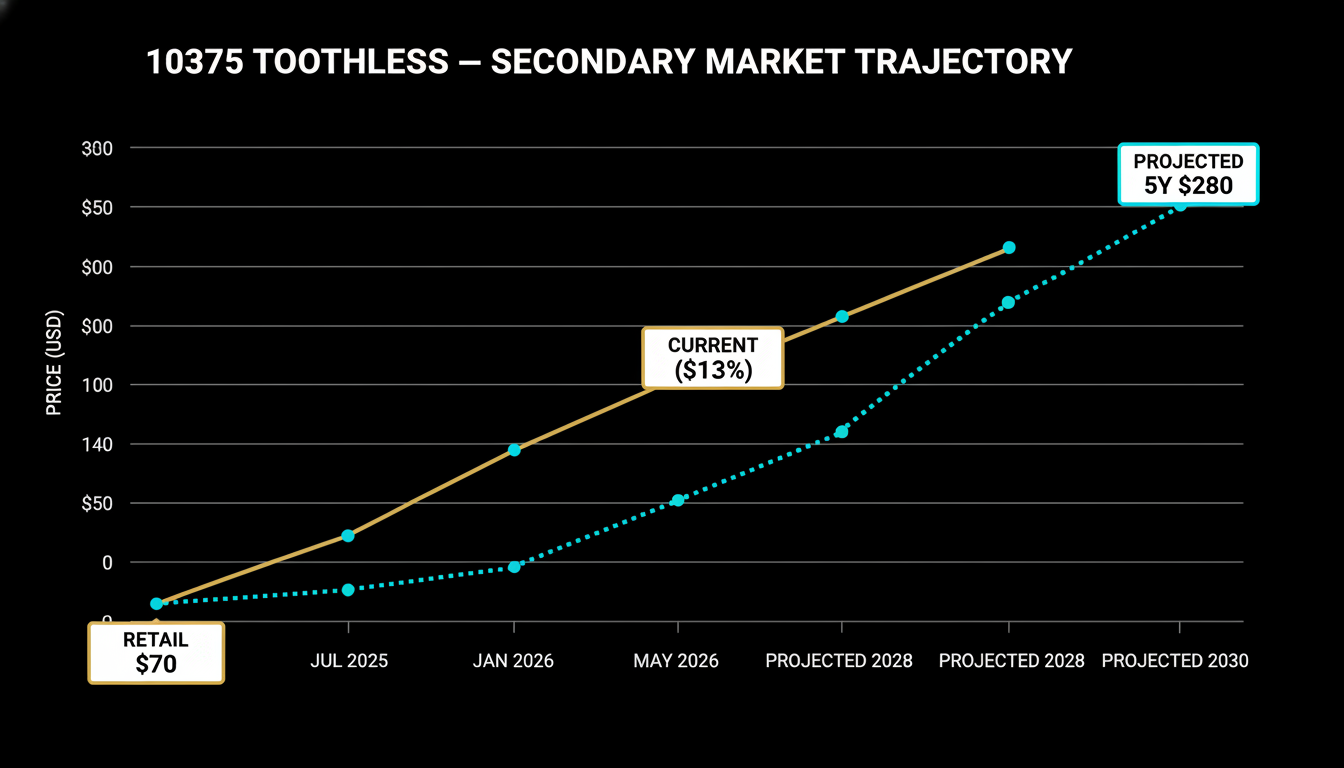
The PriceCharting data for 10375 shows sealed-mint listings at $149 average across the last 90 days (as of May 2026), versus the $69.99 retail price. That's a +113% gross move in roughly 10 months. eBay sold-listings data confirms a $135–$165 sealed range, with a median around $149.
Net of fees (eBay 13% + PayPal 3% + shipping $12 for a 1.5kg box), an actual seller nets approximately $115 — a +64% realised return, not the +113% headline. The fee drag is structural and worth keeping in mind when modelling.
Projecting forward using the established LEGO appreciation framework from [the LEGO appreciation rate analysis](/blog/lego-appreciation-rate): LEGO Icons sets historically return the 11% baseline. But 10375 is not a generic Icons set — it carries an exclusivity premium, a fresh-IP premium, and a movie-cycle premium. A reasonable expected annualized return is in the 14–16% range over a 5-year hold, putting projected sealed value around $280–$310 by 2030. That's roughly 4x retail.
That said: appreciation curves are not linear. The first year is always the most aggressive (which we've already seen with +113% gross). Years 2–3 are typically flat to slightly down as the early speculative demand settles. The real long-run climb begins around year 4–5 post-retirement.
The key uncertainty: when does 10375 retire? LEGO Icons sets typically have 18–36 month production windows. As a LEGO.com exclusive with a fresh IP that LEGO will probably want to extend, the production window could be on the shorter end — possibly retirement in 2026 or early 2027.
When to buy: three scenarios
At retail ($69.99), while still available. This is the best entry point. You're buying directly from LEGO.com at the production price, with full VIP rewards (LEGO's 6.25%-back program), zero shipping markup, and box-pristine condition. The only risk is that the set retires sooner than expected and you bought one too few. The set is in stock as of May 2026; don't assume it will be in 2026 Q4.
On secondary-market dip below $130. If the set retires soon, the secondary market will overheat briefly (typical pattern: 30–60 days of price spike to $200+), then settle back as the speculative buyers exit. If you missed retail, watching for dips below $130 sealed is the right entry. Set a price alert; the [BrickLens app](/) handles this for sets and minifigs together.
Post-retirement, after the cooling phase (2027 onwards). If you missed both windows, the third entry point is during the "year 2–3 cooling phase" after retirement — typically the cheapest sealed secondary-market window in the set's life. The downside: by then the supply curve has tightened significantly and your buy-in cost is already 1.5–2x retail.
Risks that could compress the projection
IP fatigue. The HTYD franchise has been on screen for 15 years. The 2025 live-action remake performed well but reviews were mixed. If the 2027 sequel doesn't get greenlit, or gets made and underperforms, the IP cycle softens and the 10375 premium compresses. Not the base case, but plausible.
LEGO produces more HTYD sets quickly. If LEGO follows up with 5–10 more HTYD sets across 2026–2028, the "originator" premium on 10375 dilutes meaningfully. The structural setup that makes the set special is partially that it stands alone right now. The opposite scenario — LEGO makes 10375 and nothing else — preserves the scarcity better, but is also possible.
Movie-tie-in sets historically underperform standalone exclusives. Movie-cycle premiums fade as the cultural moment fades. Compare LEGO Lord of the Rings sets after the 2010s movies wound down — they returned roughly the LEGO baseline despite huge initial demand. HTYD could follow the same pattern.
Condition risk on a relatively small box. At 784 pieces, the box is small enough that corner-damage from shipping or storage is more visually disproportionate than on a UCS box. Sealed-mint condition matters more on small sets than large ones because there's less box surface to absorb wear. Climate-controlled, vertical, single-layer storage is non-negotiable.
Where this fits in a LEGO portfolio
For most collector-investors, 10375 is a 1–2 unit allocation at retail, not a 5–10 unit speculative bet. The 5–10 unit position is what you do on a $700 UCS Star Wars flagship from the 17.6% tier, not a $70 Icons set from the 11% tier (even one carrying premiums).
Compared to other 2025 LEGO investment picks: 10375 sits below the [2026 retiring-soon flagships](/blog/lego-sets-retiring-2026) on absolute dollar-appreciation potential, but above them on percentage-return potential because the absolute price is so low. A 4x at $70 is $210 of profit; a 4x at $700 (less likely but possible) is $2,100. Different math, different roles in a portfolio.
The framework we recommend for sets like 10375 — small budget, fresh IP, high percentage upside — is in the [best LEGO sets to invest in 2026](/blog/best-lego-sets-to-invest-in-2026) playbook. Slot 10375 into the "Ideas / Icons exclusive" tier and size accordingly.
Bottom line
10375 Toothless is a real investment-grade LEGO set, not a hype play. The +113% eight-month move is grounded in three structural advantages: first-of-IP, movie-cycle, LEGO.com exclusive. Realistic 5-year projection is +200–300% sealed (net-of-fees roughly +150–230%).
If you collect for return: buy 1–2 sealed at retail while it's still in stock. Store properly. Don't open one. Plan to hold past the year 2–3 cooling phase. Use the [investment calculator](/tools/investment-calculator) to model your specific basis, holding period, and tier multiplier — and use [BrickLens](/) to set a price alert at your target exit so you don't have to remember to check eBay every Tuesday.
If you collect because you actually like How to Train Your Dragon and want a Toothless display piece: just buy it. At $70 for a non-licensed exclusive with this much detail, the value-for-money is excellent regardless of any investment thesis.
Related reading: [is LEGO a good investment](/blog/is-lego-a-good-investment), [best LEGO sets to invest in 2026](/blog/best-lego-sets-to-invest-in-2026), [LEGO sets retiring in 2026](/blog/lego-sets-retiring-2026).