How Much Does the LEGO Titanic Cost? $679.99 Retail, $729 Resale, and the 2026 Investment Case
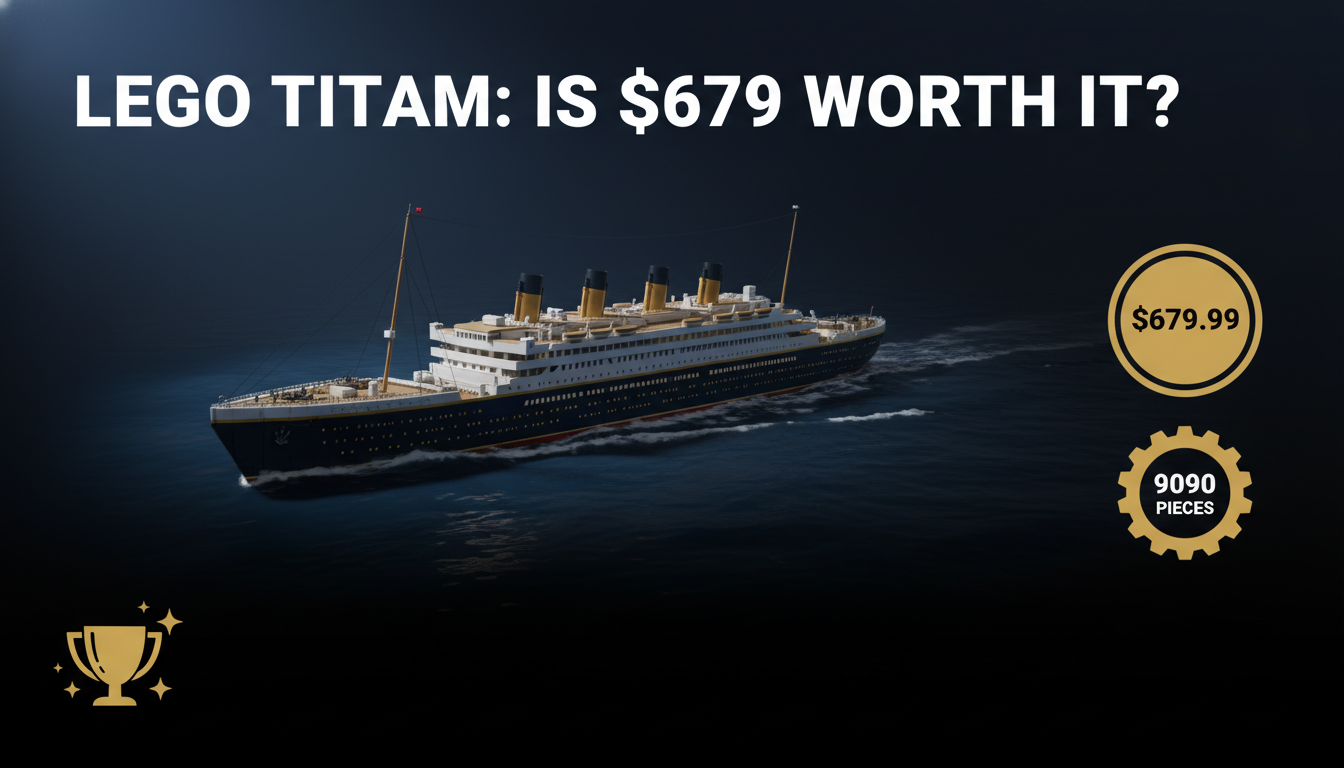
Short answer: the LEGO Titanic (set 10294) retails at $679.99 USD at LEGO.com and official LEGO stores. Sealed copies on the secondary market averaged around $729 as of mid-2026 — approximately 7% above retail while the set is still in active production. Post-retirement projections based on comparable large-format Icons set performance put the sealed value at $828-867 by 2028-2029.
That is the quick version. The rest of this guide covers where those figures come from, what the $50 price increase from the original $629.99 launch price means for buyers, how the price per piece compares to the rest of the LEGO catalog, where you can actually buy it, and whether the investment case holds at current prices.
What set 10294 is
The LEGO Titanic is part of the Icons line (previously branded as Creator Expert). It was released in November 2021 at $629.99 and represents the RMS Titanic — the full ship exterior and a cross-sectional interior, accurate enough that longtime Titanic enthusiasts typically recognize it immediately.
The core specifications make it one of the most physically impressive LEGO sets ever produced:
Piece count: 9,090 — one of the three largest LEGO sets in history by piece count
Dimensions built: 135 cm (53 inches) long, 44 cm tall, 17 cm wide
Weight built: approximately 6.8 kg (15 lbs)
Distribution: LEGO.com and official LEGO stores exclusively — not available on Amazon, Target, or any third-party retail
Release date: November 8, 2021
Original retail price: $629.99 USD
Current retail price: $679.99 USD
The set splits into three sections for display and storage, each showing the interior rooms — the grand staircase, first-class dining saloon, boiler room, turbine room, and cabins at multiple class levels. The level of detail is unusually high for a LEGO set at this scale; the ship's exterior matches period photographs with near-accurate funnel placement, anchor chains, and hull plating detail.
Why the price went up $50
LEGO raised the Titanic from $629.99 to $679.99 — an 8% increase — citing raw material and logistics cost inflation across their premium line. The increase happened across multiple higher-priced sets in the $499-$849 range during 2023-2024.
For buyers, the practical impact:
An investor who bought at $629.99 in 2021 has a $50 lower basis than a 2026 buyer
The secondary market average of $729 represents a 14.5% premium over the 2021 price but only a 7.2% premium over the current $679.99 retail
Post-retirement appreciation is typically calculated from the final retail price, so 2026 buyers and 2021 buyers will converge toward similar percentage gains, but the 2021 buyer has 5 years of compounding already locked in
The price increase has not suppressed secondary-market demand — $729 average is still above the new retail price, which means buyers are already pricing in expected retirement.
Price per piece: genuinely one of LEGO's best values
At $679.99 for 9,090 pieces, the Titanic works out to $0.0748 per piece.
Context: the LEGO catalog average for mainstream sets runs $0.11-0.12 per piece. Premium adult-collector sets typically run $0.13-0.17 per piece. The Titanic's $0.075 is among the best value-per-piece figures across the entire LEGO lineup, comparable only to the Colosseum (10276: 9,036 pieces, $549.99 at $0.061/piece) and the Eiffel Tower (10307: 10,001 pieces, $629.99 at $0.063/piece).
Why does this matter for investment? Sets with strong price-per-piece value attract a broader base of buyers: pure collectors, people who enjoy the build challenge, and "display collectors" who want a large-scale set for their home. Multiple buyer types competing for a finite sealed supply amplifies the post-retirement price appreciation. Sets with weak price-per-piece attract narrower audiences — primarily completionist collectors — which means a smaller demand pool when it's time to sell.
Where to buy the LEGO Titanic
The LEGO Titanic is a LEGO.com exclusive. That means:
Available: LEGO.com (lego.com/en-us), official LEGO brand stores in malls and airports
Not available: Amazon, Target, Walmart, Costco, or any third-party retailer that hasn't imported it independently
Occasional availability: eBay and BrickLink (sealed, from sellers), typically at 5-15% above retail
Status as of May 2026: in stock at LEGO.com, though availability has fluctuated between "in stock" and "temporarily unavailable" at various points
The LEGO.com exclusive distribution is a meaningful investment factor. Sets available through mass-market channels (Target, Amazon) often show up in clearance or liquidation channels years after retirement — a "ghost supply" that slows early post-retirement appreciation. LEGO.com exclusives have clean retirement cutoffs: when LEGO stops selling it, supply stops. Period.
International pricing for reference:
UK: £554.99 - £589.99
EU: approximately €699.99
Australia: approximately AUD $999.99
Canada: $899 CAD
The secondary market right now
As of mid-2026, sealed LEGO Titanic copies on BrickLink and eBay trade at:
Low end: $721
High end: $822
Average (sealed, new): approximately $729
The 7.2% premium to retail while still in production is unusual. Most sets in active production trade at or below retail because buyers can simply order from LEGO.com. The Titanic's persistent secondary premium reflects two dynamics: periodic LEGO.com stock-outs pushing buyers to secondary markets, and early investor positioning ahead of expected retirement.
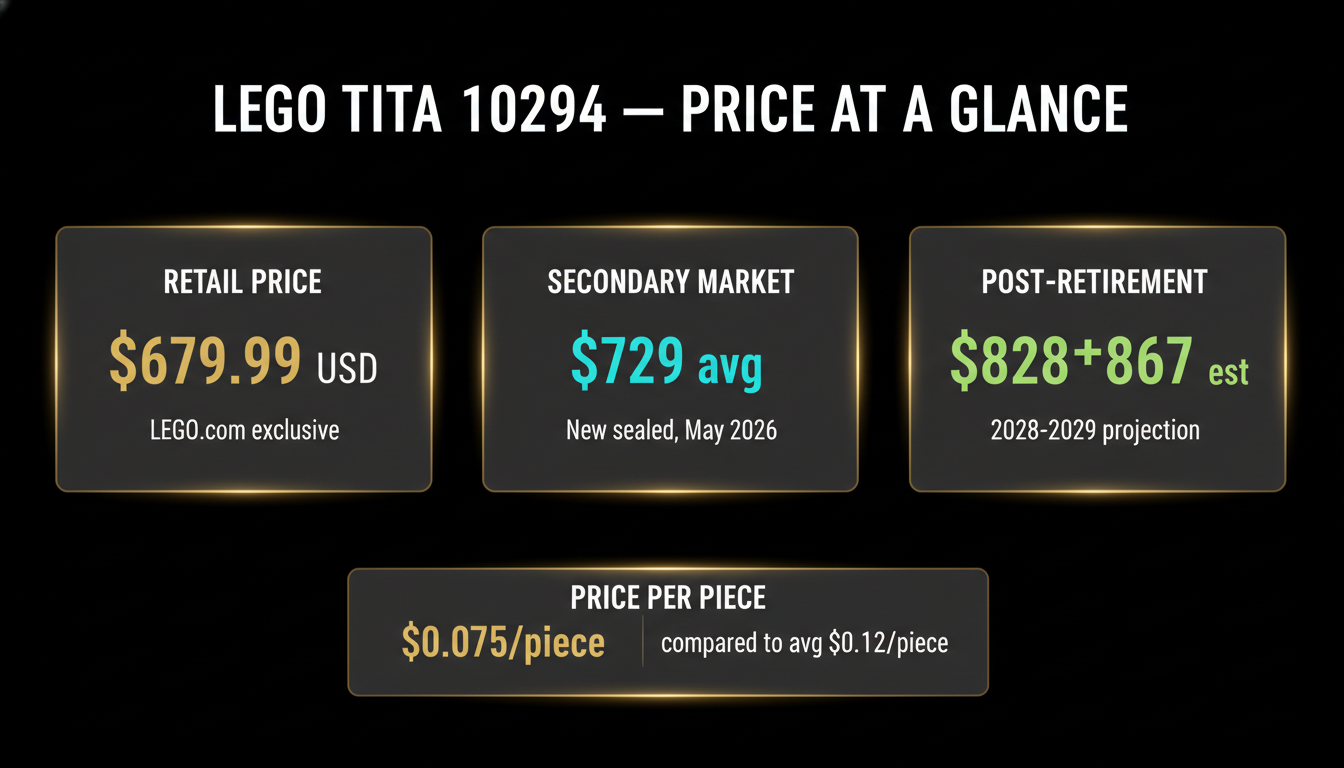
What this means practically: the secondary market has already begun pricing in retirement. If you buy at $729 on BrickLink today instead of $679.99 at LEGO.com, you are paying a $49 premium for the convenience. From a pure investment standpoint, always buy at retail when the set is still available — paying the secondary premium compresses your eventual ROI significantly.
When is the Titanic retiring?
LEGO has not announced a retirement date for 10294. Based on the production cycle patterns for large Icons-tier sets at this price point — typically 4-6 years in active production — and given the November 2021 launch, the community consensus estimate is mid-to-late 2026 for retirement.
LEGO's standard signal before retirement: sets transition from "in stock" to "low quantity" or "while supplies last" on LEGO.com, then disappear from the store entirely before an official discontinuation notice. Monitor LEGO.com stock status if you are considering a purchase. "Low quantity" status generally means retirement is 2-4 months away.
Note: some LEGO community commentary from June 2025 suggested caution around the Titanic specifically — concern that investor-driven buying has pre-loaded the market with sealed copies beyond what eventual collector demand will absorb. This is a real risk worth acknowledging: if sealed supply from investors significantly exceeds long-term collector demand, prices can plateau or dip 2-4 years post-retirement before recovering. This happened briefly with the Eiffel Tower (10307) after its retirement. The risk is not unique to the Titanic, but the set's price point ($679.99) means investors have put meaningful capital in — making the supply overhang a real possibility.
Post-retirement price projection
Based on BrickEconomy projections and comparable large-format Icons set data:
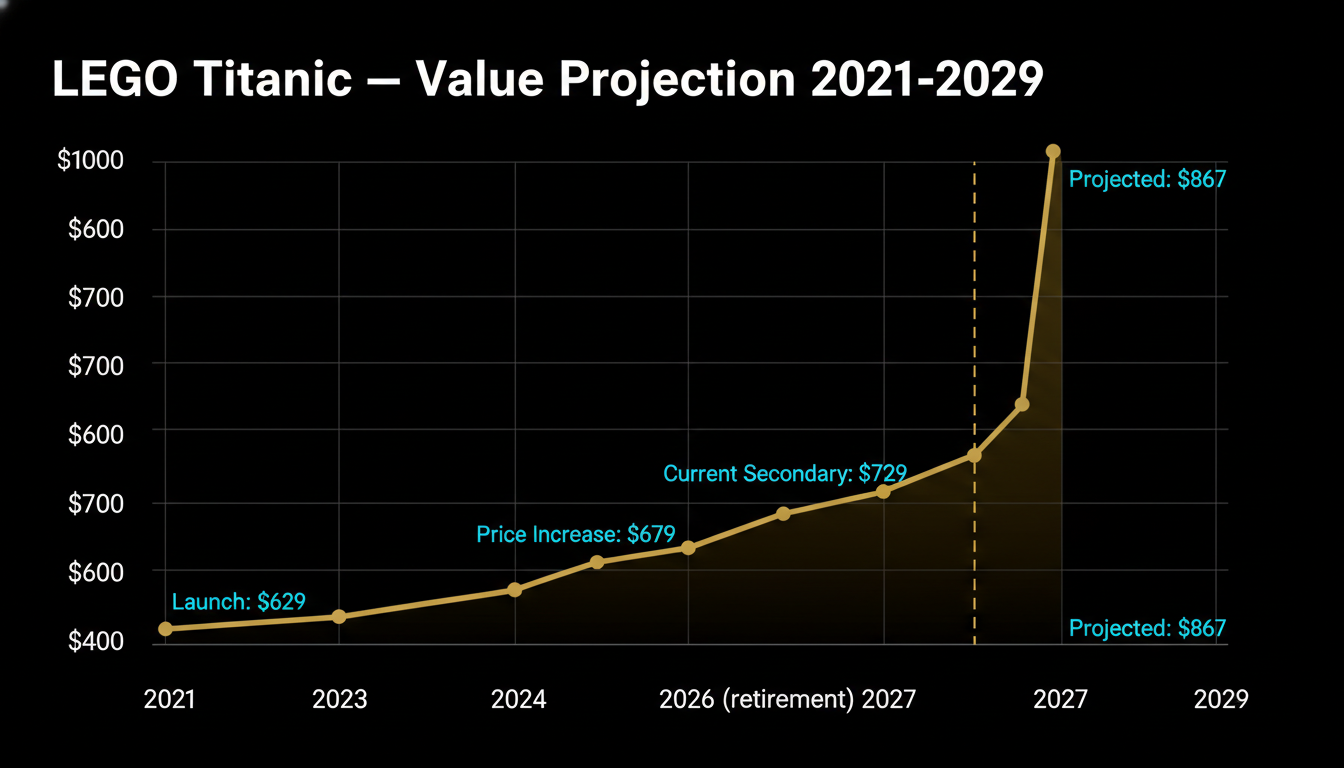
At retirement (est. 2026): $729-750 (secondary market is already tracking this)
2 years post-retirement (2028): $828-867
4 years post-retirement (2030): $930-975
These projections apply 6% annual appreciation post-retirement, which is BrickEconomy's conservative baseline for large-format Icons sets. This is below the overall LEGO average of 11% because large sets ($500+) have narrower collector bases than mid-range sets, are harder to ship (compressing liquidity), and require more storage infrastructure from buyers — all factors that slightly dampen appreciation compared to the broader market.
The Millennium Falcon (75192) is the most instructive comparison: large-format flagship set, similar Icons-tier classification, $849 retail, now at $1,100-1,200 sealed roughly 5 years after launch. That tracks approximately 10% annually — above the 6% BrickEconomy baseline but below the UCS Star Wars 17.6% tier average (because the Falcon still benefits from its UCS classification while the Titanic is a straight Icons set).
How the Titanic compares to other large LEGO sets
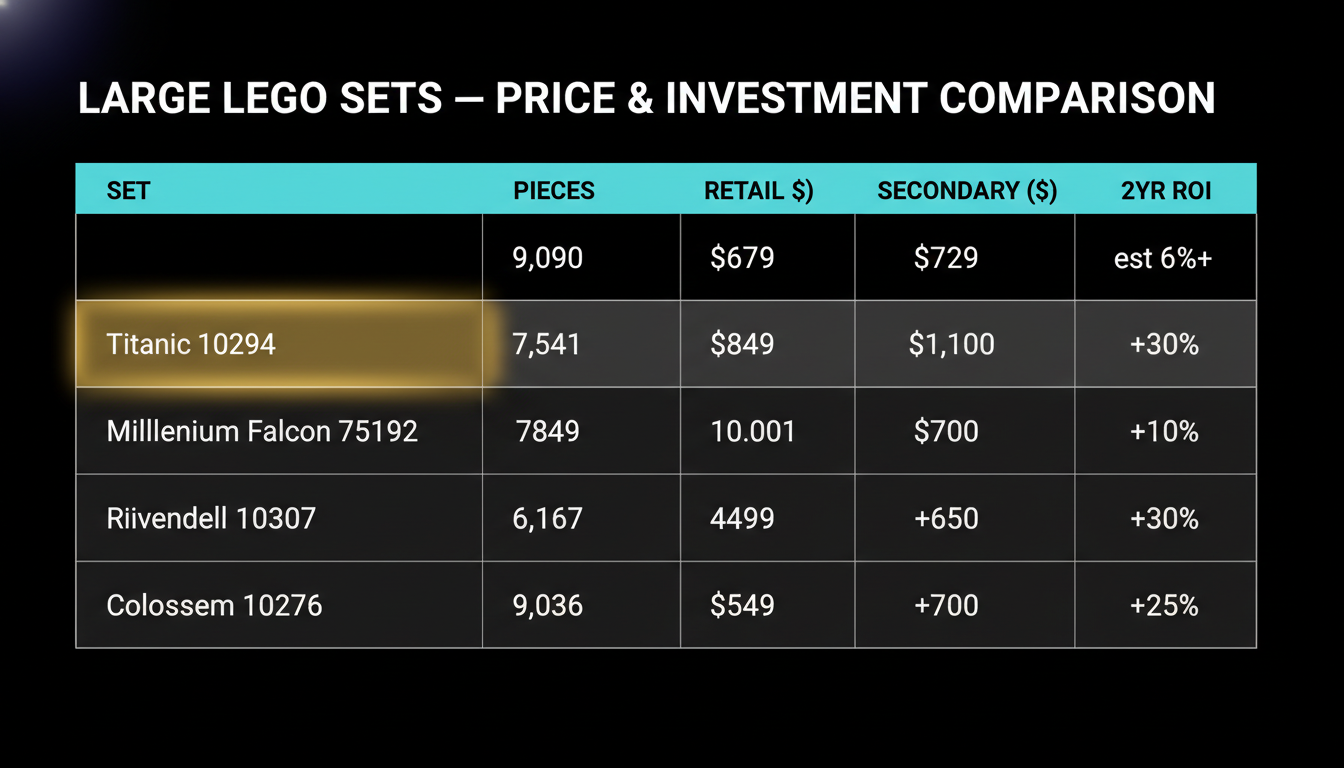
| Set | Pieces | Retail | Secondary (2026) | Projected ROI |
|---|---|---|---|---|
| Titanic 10294 | 9,090 | $679 | ~$729 | 6%/yr post-ret |
| Millennium Falcon 75192 | 7,541 | $849 | ~$1,100 | +30% over 5 yrs |
| Eiffel Tower 10307 | 10,001 | $629 | ~$700 | ~10% (2 yrs) |
| Rivendell 10316 | 6,167 | $499 | ~$650 | ~30% (3 yrs) |
| Colosseum 10276 | 9,036 | $549 | ~$700 | ~25% (4 yrs) |
Rivendell stands out as the bullish comparable: launched at $499, at $650 sealed by 2026 in roughly 3 years — 30% cumulative gain while still in production. Rivendell benefits from Lord of the Rings cross-demographic appeal (similar to how the Polaroid attracts non-LEGO buyers). The Titanic has its own cross-demographic appeal — Titanic enthusiasts who would not normally buy LEGO — which supports a similar dynamic.
The Colosseum (10276) is the closest structural analog to the Titanic: large piece count, historical subject matter, LEGO.com exclusive, similar retail price. It reached approximately 25% cumulative gain 4 years post-retirement.
Should you buy the LEGO Titanic in 2026?
Three scenarios:
Scenario A — You want to build it. Buy at retail now. At $679.99 for 9,090 pieces and a 5+ hour build, the value per building-hour is exceptional. The interior room detail is rewarding. Do not wait: if retirement is late 2026, retail window is closing.
Scenario B — You want to hold it sealed. Buy at retail now. At $679.99 entry, secondary market at $729 today, and projection at $828-867 by 2028, you are looking at a realistic 22-27% cumulative return over 2-3 years — approximately 7-9% net annually after fees. That is solid for a large, illiquid, flagship set with limited downside from its current near-retail secondary market floor.
Scenario C — You are buying on the secondary market. At $729, you have paid the 7% premium. Your basis is higher, which compresses ROI. A $829 exit in 2028 from a $729 basis represents 7% cumulative over 2 years — approximately 1-2% net annually after eBay and shipping fees. Index funds are a better financial choice at that entry. Buy secondary-market only if you want the set and LEGO.com is out of stock.
Recommendation: buy at retail if available, either to build or hold sealed. Do not pay the secondary premium for pure investment. Use the [LEGO Investment Calculator](/tools/investment-calculator) to model your specific entry price and hold period. For context on how large-format sets fit the broader LEGO investment landscape, see [LEGO Investment Guide 2026](/blog/lego-investment).
The bottom line
The LEGO Titanic (10294) costs $679.99 USD at retail — one of the largest LEGO sets by piece count at one of the best price-per-piece ratios in the catalog. It is already trading above retail on secondary markets while still in production. Post-retirement projections based on comparable large Icons sets put sealed value at $828-867 by 2028-2029.
As a build: among the most impressive LEGO experiences available. 9,090 pieces, detailed interior rooms, 135cm of displayed ship.
As an investment bought at retail: 7-9% net annually after fees over 3-5 years, with real downside risk from supply overhang if investor-driven buying created excess sealed inventory.
As a secondary-market purchase at $729+: margin is too thin. Buy it because you want the set, not because the numbers work.
Check [How to Track Your LEGO Collection Value](/blog/how-to-track-money-spent-on-lego) if you are tracking the Titanic alongside other sets in a portfolio.