The Cheapest LEGO Sets That Are Actually Worth It (2026 Guide)
The query "cheapest lego sets" gets about 8,100 monthly searches. Almost every result that ranks for it makes the same mistake: it sorts by retail price ascending, lists a bunch of 30-piece polybags, and calls it a day. That's not a buying guide — it's a sort. A real buying guide answers three questions: what is the actual cost-per-piece, does the build quality match the price, and does it hold any resale value.
This post walks the honest framework for cheap-LEGO buying. Spoiler on the headline: the cheapest LEGO per piece is not what most "best cheap LEGO" lists tell you — and the sweet spot for "cheap but worth it" sits at the $15–$30 tier, not the under-$10 tier.
The right way to measure "cheap" — price per piece (and what's wrong with just that)
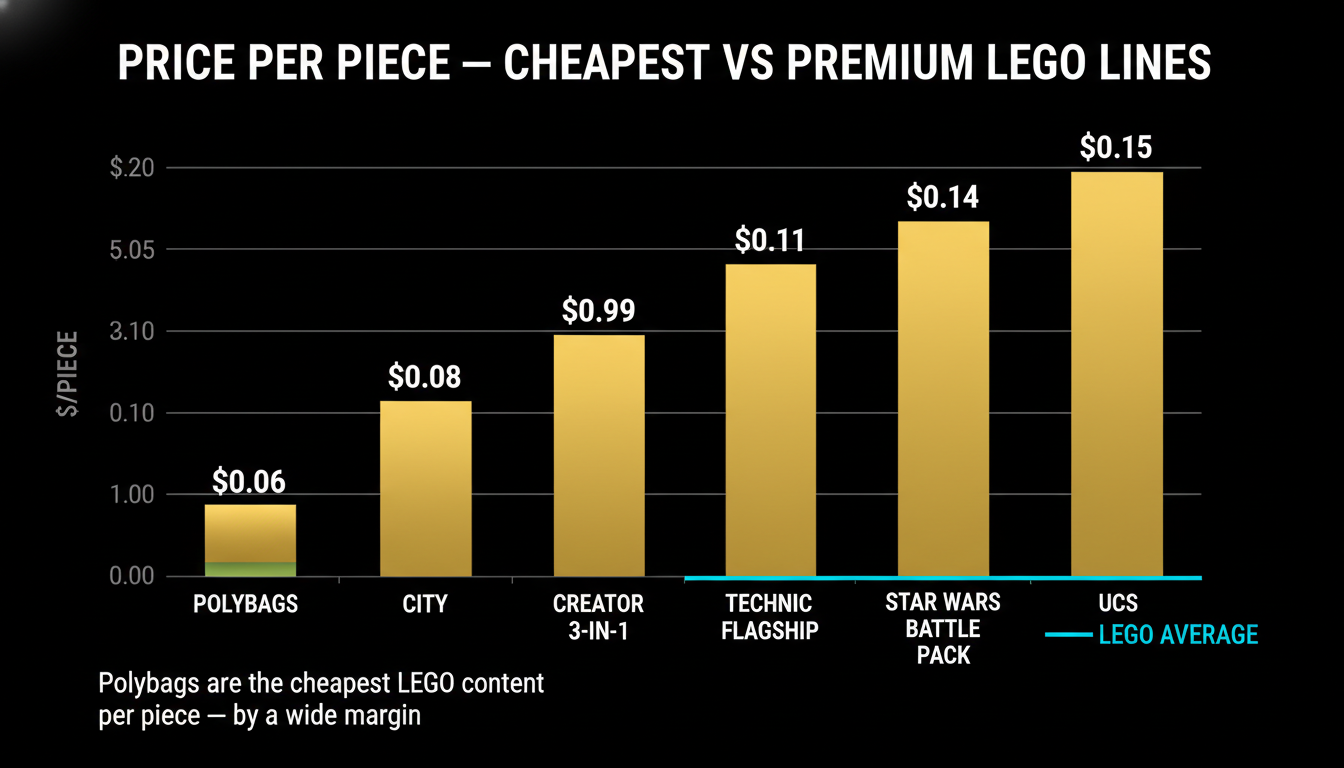
The standard LEGO buyer's metric is dollars per piece. The LEGO baseline is roughly $0.10/piece — that's the average across all current production. Anything below $0.10/piece is cheap by tier average; anything above $0.10/piece is paying a premium for licensing, exclusivity, or build complexity.
Current $/piece across the major LEGO lines (May 2026, retail prices):
| Line | Typical $/piece | Why |
|------|------------------|-----|
| LEGO Creator 3-in-1 | $0.07-$0.09 | Generic parts, no licensing |
| LEGO City | $0.08-$0.10 | Mass-market scale |
| LEGO Polybags | $0.05-$0.11 | Volume-bait pricing |
| LEGO Friends | $0.09-$0.11 | Specialty pieces add cost |
| LEGO Technic flagship | $0.10-$0.12 | Engineering parts more expensive |
| LEGO Star Wars (standard) | $0.11-$0.14 | Licensing fee |
| LEGO Star Wars Battle Pack | $0.14 | Minifig-heavy, premium pricing |
| LEGO UCS | $0.13-$0.17 | Display-grade, large piece counts |
| LEGO Disney 18+ | $0.10-$0.14 | Licensing + adult-line markup |
The mistake $/piece-only thinking makes: it treats a 1×1 stud and a custom-printed minifig torso as equivalent. They're not. A $30 set with 200 generic 1×1 studs ($0.15/piece) is *worse* value than a $30 set with 100 mixed pieces including 2 printed minifigs ($0.30/piece) — because the minifigs alone might resell for $20 on BrickLink while the studs are essentially fungible.
The honest measure is price per piece PLUS resale-recoverable value (minifigs, rare elements, printed pieces). Most cheap LEGO articles skip the second half, which is why they recommend Creator 3-in-1 sets at $0.07/piece without mentioning that those builds have approximately zero resale demand.
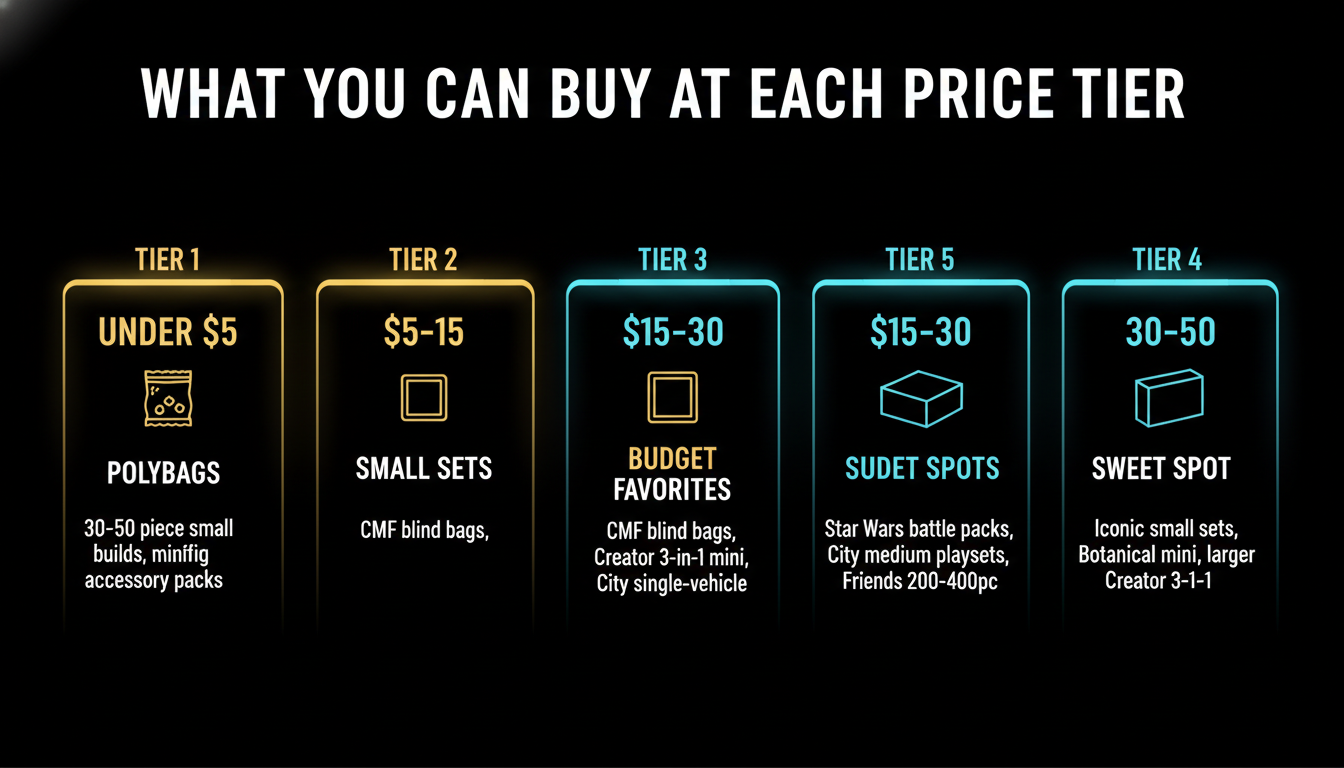
Under $5: polybags (good if you're patient with the lifecycle)
LEGO polybags retail at $3.99–$5.99 for 30–80 piece sets. The cost-per-piece sits at $0.06–$0.11 — competitive but not category-leading. The real value of polybags is the *minifigure*: most polybags include 1 minifig, often exclusive to that polybag, which can resell standalone for $5–$15 once retired.
The buy strategy: grab the polybag when it includes a figure you'd otherwise pay $10+ for standalone. Recent examples of polybag minifigs that retired into $15–$25 standalone secondary market: City Adventures characters, certain Marvel and DC minifigs from promotional polybags, holiday-themed seasonal exclusives.
The catch: polybag availability is regional and short-window. LEGO releases ~12–20 polybags per year globally, and most are gone from retail within 6 months. Stone Wars' [polybag roundup](https://stonewars.com/news/lego-sets-under-20-dollars) is the canonical source for what's currently shippable in the US/EU. Brickset's "polybag" tag is the second source.
If you're collecting for the minifigs, polybags are the cheapest entry. If you want the bricks for building, skip the polybag tier — the $/piece isn't actually better than larger sets and the parts mix is too narrow to be useful.
$5–$15: small sets (the worst-value tier)
The $5–$15 range is paradoxically the *weakest* value tier in the LEGO lineup. Sets in this range typically:
Are 50–150 pieces, mostly basic plates and studs
Include 1 minifig (often a generic or recoloured base figure)
Have minimal play features or display value
Almost never appreciate post-retirement
The $/piece in this range is actually competitive ($0.08–$0.10) but the absolute build size is too small to deliver meaningful play or display value, and the minifig is rarely exclusive enough to drive resale. Examples to avoid: most LEGO City "fire truck" or "police car" single-vehicle sets at $9.99, the bulk of LEGO Friends sub-$15 sets, generic Speed Champions sub-$20 sets.
The exceptions worth buying: LEGO Ideas mini-sets, CMF blind bags (covered in our [LEGO minifigure scanner guide](/blog/lego-minifigure-scanner)), and tie-in promotional sets that include scarcity-driven minifigs.
$15–$30: budget favorites (the actual sweet spot)
This is the tier where the math gets honest. At $15–$30 retail, you're getting:
150–400 pieces of build content
3–9 minifigures (especially in battle packs)
Genuine play or display value
The first tier where post-retirement appreciation becomes meaningful
The category leaders:
LEGO Star Wars Battle Packs ($29.99 typical). Currently set 75372 Clone Trooper & Battle Droid Battle Pack: 215 pieces, 9 minifigures, ~$3.33 per minifig. Standalone minifig value adds up to ~$51 against $30 retail. We walked the full economics in our [Star Wars battle droids guide](/blog/lego-star-wars-battle-droids). Battle packs are the highest-resale-value tier in the budget category.
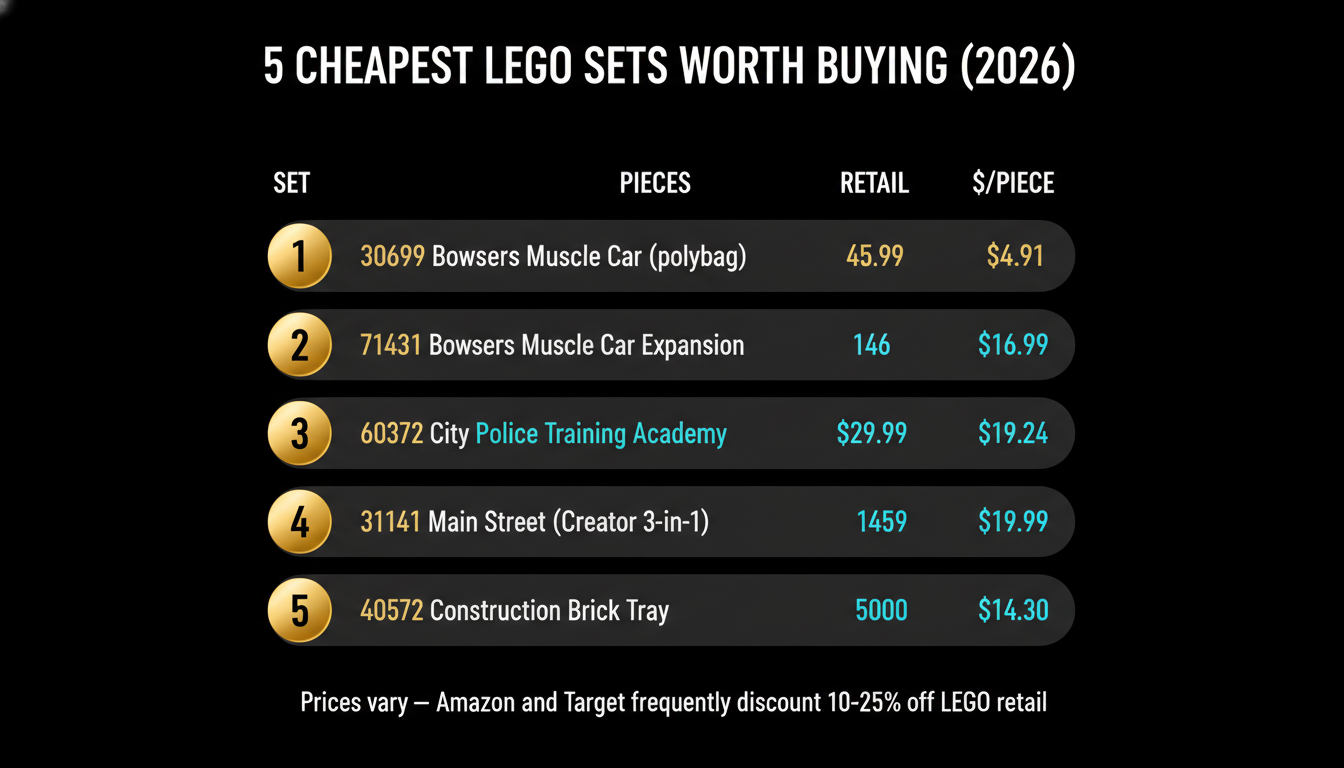
LEGO Creator 3-in-1 medium sets ($19.99–$29.99). Set 31141 Main Street (1,459 pieces at $19.99) is currently the absolute floor on $/piece across all LEGO at $0.014/piece. The trade-off: low resale value because Creator 3-in-1 sets target builders, not collectors. Buy for parts or play, not for return.
LEGO City medium playsets ($19.99–$29.99). Set 60372 City Police Training Academy: 823 pieces at $19.99 = $0.024/piece. Similarly strong piece-economy, similarly weak resale. Buy for kids, not portfolio.
LEGO Speed Champions standard sets ($24.99). ~280 pieces with 1 licensed-car build. Solid $/piece (~$0.09), unique licensed builds (Ferrari, Lamborghini, Porsche), modest resale-bonus from car-enthusiast crossover buyers.
LEGO Ideas sets that landed in this tier ($24.99–$29.99). Less common but the best buy-and-hold in the budget category. Limited production runs by design. Example: set 40531 Lars Family Homestead Kitchen (Ideas exclusive 2022) currently trading at $80 — a +220% gain on a $25 retail in 4 years.
$30–$50: the next tier up (worth knowing about)
For completeness, the $30–$50 range:
300–800 pieces, more advanced builds
More minifigs or detailed single-character builds
Includes most LEGO Botanical Collection sets, larger Creator 3-in-1, Icons "small" sets, mid-tier Star Wars
Post-retirement appreciation becomes a real factor, especially on licensed sets
This tier is technically above "cheapest" but it's the natural step-up if you want any real LEGO. Below this tier, you're mostly buying minifigs and small builds; at this tier, you start getting genuinely substantial sets.
Notable picks: LEGO Botanical Collection ($29.99–$59.99 range, mostly under $50), 31133 White Rabbit Creator 3-in-1 ($34.99, 731 pieces), most current Star Wars helmet collection sets ($69.99 retail but frequently discounted to $50–$55).
Where to actually get cheap LEGO (without overpaying)
Amazon LEGO category. Routinely discounts 10–25% off retail on popular sets. Amazon's discounts skew toward City, Creator, and Star Wars — the high-volume categories. Less aggressive on Icons, Ideas, and UCS sets where LEGO controls the channel more tightly. Set price alerts via [BrickLens](/) on specific sets and you'll catch the dip windows automatically.
Target circle / Target RedCard. Routinely 5–15% off, occasionally 25% off during Q4 promos. Best for City, Friends, and Creator. Less inventory on Icons / UCS / Ideas.
Walmart. Comparable to Target. Watch for clearance markdowns post-Q4 (January–February) when seasonal inventory clears at 30–40% off.
LEGO.com VIP rewards. 6.25% back on all purchases, redeemable as discount codes. Not the cheapest absolute price but the only channel for exclusives (Ideas sets, Icons sets, LEGO.com-exclusive Disney 18+ flagships). For sets that *only* exist at LEGO.com — like the [How to Train Your Dragon 10375 Toothless](/blog/how-to-train-your-dragon-lego) — this is the only retail option.
Black Friday / Cyber Monday (late November). Best single window of the year. LEGO directly discounts hard-to-find sets, Amazon and Target compete aggressively, and clearance from Q3 product lines hits 30–40% off. If your buy list isn't time-sensitive, wait for late November.
LEGO Insiders sales (formerly LEGO VIP weekend sales). 2–4x per year, 20–25% off select sets. LEGO emails Insiders members in advance. Free to join.
Avoid: LEGO Pick-A-Brick as a "cheap LEGO" channel. Pick-A-Brick is for specific replacement parts. Per-stud cost is roughly 4–6x higher than buying complete sets and harvesting parts. Useful for MOC builders, not for cheap-LEGO buyers.
The trap: cheap sets that aren't worth it
Three patterns to actively avoid:
Small City single-vehicle sets at $9.99–$12.99. Worst per-piece value adjusted for parts utility. 50–80 pieces of largely identical plates plus one wheel assembly. Nothing displays well, nothing resells, nothing has play value beyond rolling.
Off-brand "compatible" sets. MEGA, Cobi, Lepin clones — sometimes 50–70% cheaper than LEGO equivalents. Build quality is variable, fit tolerances are looser, resale is zero. Save the $5 by skipping the set entirely; off-brand isn't comparable.
Holiday seasonal sets discounted post-season. December 26 brings 50–70% off LEGO holiday sets. Tempting. Almost never worth it — the seasonal sets are designed for novelty, not appreciation. Once the holiday passes, both display and resale demand vanish for 11 months. The exception: LEGO Winter Village Collection (Icons line), which holds value despite the seasonal theme.
Bottom line
If "cheap LEGO" means "lowest absolute dollar amount that gets you a real set": polybags at $5 or Creator 3-in-1 small builds at $14.99. Both deliver some LEGO content for minimum outlay.
If "cheap LEGO" means "best value per dollar including parts utility and resale": the $15–$30 tier with Star Wars Battle Packs and LEGO Ideas exclusives wins decisively. 75372 Clone Trooper & Battle Droid Battle Pack at $29.99 is the current single best example.
If "cheap LEGO" means "investment-grade at the budget tier": look at LEGO Ideas sub-$30 releases — rare but they exist, and they outperform every other budget category on long-run resale.
For per-set ROI projections grounded in the [HSE tier multipliers](/blog/lego-appreciation-rate), the [investment calculator](/tools/investment-calculator) handles this exact analysis. For real-time price alerts on specific budget sets across Amazon, Target, and LEGO.com — so you don't miss the 25% off windows — [BrickLens](/) is the iOS app built for it.
Related reading: [most valuable LEGO sets](/blog/most-valuable-lego-sets), [LEGO sets retiring in 2026](/blog/lego-sets-retiring-2026), [is LEGO a good investment](/blog/is-lego-a-good-investment).